12 months on Vanilla, Gnarlydog and I revisted Mud Island.
With a benign forecast and Gnarlydog's renowned lack of interest in flat water paddling, the only challenge on this 35km trip would take place in the mind. Fortunately Gnarly was blessed with great companions and an interesting destination.
En route to Mud, Gnarlydog spotted movement across the calm passage. It appeared to be kayaks also moving north. One, clad in bright orange was particularly visible 4km away. If you want to be seen on the water, those high vis tops favoured by some really do work!
Close to St Helena Island south of Mud, my attention was drawn below the surface of the water. The floor was bare here except for hundreds of small cone shells. As the water depth increased, I began to see sting rays and passed in amazed silence over a dozen turtles on the bay floor. A minor commotion in the water and swirls of black ink, left behind by a defensive fast moving squid captured my attention. Vanilla alerted us to an eagles nest precariously built on the very top of one of the super tall radio towers. It seemed to be an optimistic engineering feat but made us wonder how long any chicks would last when their first unpracticed flight was such a long way down.
Crossing the deep channel between St Helena and Mud Island, the boys asked me to investigate some movement in the water ahead. As I approached the source they eagerly asked 'is it a shark'? While it is pupping season, it was only a large ray.
At Mud we entered the moat like lagoon surrounding this part of the island and approached the creek entrance just as 2 kayakers, one wearing a bright orange top, were exiting. kayakdiary.net's Mark & Sue were the distant kayakers seen earlier, who were also exploring Mud Island on this calm day. Leaving Mark and Sue to continue their exploration, we entered the creek.

Surprisingly, there is still matter from 2 of the 3 whales decomposing among the mangroves but only the biggest bones of the 3 whales remain on the creek floor.
The creek is quite shallow even on a spring tide and the missing bones are too heavy to have simply washed away. Perhaps the EPA or souvenir hunters have removed them.
Weaving through the mangroves past the remains, Vanilla and Gnarlydog chose to follow the creek while I stayed behind and took photos to compare with Kate's, taken 12 months ago.

2009_Kate Yeomans_used with permission

2010_Tess Dodd
Up close, the smell was overpowering. The rancid stench stayed with me for most of the day.
The edges of the flattened remains were fatty and drifting with the movement of the water. The top had hardened and was littered with mangrove leaves.

Through the shallow water I could see vertebra and a rib lying on the floor beneath the floating remains. When my kayak nudged the fatty mass it startled a school of fish approx 30cm in length which swam out from underneath. While it looked and smelled disgusting, it was very interesting to see how long decomposition was taking and the effect on the immediate environment.
Gnarly called out to me concerned that I may have passed out from the smell. I stayed taking photos until I could bear the smell and mosquitos no more and rejoined him to paddle further up the creek.
The creek is a tight shallow channel surrounded by a submerged field of mangroves giving the feeling of being in a maze. On a spring tide you could lose your way. Vanilla was nowhere to be seen or heard which is not unusual given his low profile nature. We were unsure which direction he had taken so followed what we thought was the channel. Vanilla eventually emerged driven back by agressive swarms of mosquitos. 'Sand-Fla-Van'** was hastily produced and applied to already bitten skin.

We returned to the lagoon as the tide began to ebb enjoying the chance to paddle inside the islands protective coral barrier.
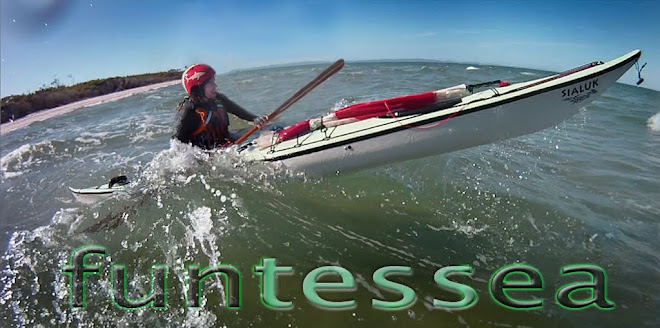
Conditions remained calm and returning to our launchsite we were compelled to create our own excitement, chasing and catching the small waves in the chop and mini tideraces along the way. Vanilla raised his sail but forward paddled faster than the weak tail wind. I was very happy to be in my Nordkapp LV Sialuk as my expedition boat would not have been as much fun in these small conditions.
**'Sand-Fla-Van' (Sand-Fly-Vanilla) was created by Vanilla using non toxic ingredients to replace commercial products containing DEET which destroy expensive outdoor gear. During the past 12 months, we have used it almost exclusively on trips with satisfying results. It is also multi use and has been used to stop bites itching and as a low grade anticeptic.


