image Damiano Visocnik_used with permission
I've been out of action for several months and I was eager to return to kayaking. I had some concerns about my paddle fitness and skills. Afer a solid day paddling, testing my rolling and messing around in small waves, I felt strong and happy. Heading out in the evening with Gnarlydog to enjoy the sunset, was the perfect way to end the day.
Playing in rough water off Bribie Island in Moreton Bay, I noticed a strange looking dolphin jump out of the water and flip onto its back not far from me. I quickly paddled over to have a closer look, but it had disappeared. There are at least 8 dolphin species recorded in Moreton Bay so it is not uncommon to see them when paddling in the area. However since the Brisbane floods, visible marine activity has been minimal so I was quite excited by the close sighting. used with permission_Ken Douglas A short time later, as we continued to play, the same thing happened again. This time Gnarlydog also saw the dolphin and pointed out that it wasn't a dolphin, but a shark approx 4 - 5 ft long. It was quite dark on top with a white belly. The obvious difference was the blunt or stubby head. Bull shark in 1m water_Alkok_used with permission I did not feel overly concerned as the shark showed very little interest in us and while some rolling was going on, we were mostly above water in our kayaks. We continued playing for another hour or more, the shark splashing occasionally before disappearing altogether. I was keen to find out what type of shark it was as I had never seen one jump out of the water like that, especially so close to us. I contacted shark expert Valerie Taylor to ask her opinion: Shark Conservationist and Underwater Film MakerValerie Taylor AM Tess You have just described an average shark. Nearly all have white or pale stomachs and are darker on top. The blunt head sounds like a bull shark and they will jump out of the water. I have seen it several times. Do not ever get in the water when the vis is down. Predatory sharks hunt by sight and vibration. Lacking hands, if they cant see something splashing around in the water they can and often do investigate the unusual by biting. You were quite safe in your kayak specially if staying still like a log. Female Bull sharks at this time of the year are swimming into the harbours and rivers to pup. They do this so the males don't eat the new born sharks. The baby sharks will stay in the inland waters until they are big enough to hold their own in the ocean. Regards Valerie Taylor *** Bull Shark_Delusion Productions_used with permission ***Interview with Valerie and Ron Taylor
Wind forecasts above 15kn are a great time to head into the tidal flow where opposing forces create nice rough water to play in. Getting close to GDog, very close...
"In my opinion, you can never practice the sculling brace enough. What I like to do is to get into a sculling brace position, looking up, hands under the paddle, let yourself sink and come up on the other side, to the sculling brace. Doing this back and forth very slowly is a good workout. It's good for learning orientation when you’re under water, teaches you to relax and be ok with being in the water". Warren Williamson
Taking advantage of another rainy weekend when no one else was on the water, I played and had fun, rolling one day and surfing the next. As Warren says, the sculling brace is helpful in learning underwater orientation and relaxing underwater, both important for the kind of sea kayaking I enjoy.
Paddling out through the clear green water the sky was ominous and the falling rain stung my eyes. This small discomfort was quickly forgotten as each wave lifted the stern of my kayak for another ride.
Dreamer Matt_Vanstix Aleut paddle Queensland and my hometown Brisbane, is recovering from the unprecedented weather events of January 2011. Several local beaches and waterways remain closed to swimmers as a precaution. On some of the hottest days of Summer, the usually popular beaches are eerily deserted. It’s no secret that playing around in my kayak with my stick makes me happy. Kayaking is a chance for me to be fully present in the moment, not thinking about anything except my body, the paddle, the kayak and the water. Even when I muck it up, it’s still fun. I play to improve my skills and I like that I don’t have to be technically perfect to enjoy myself. Gnarlydog sculling during a play session As I play, get wet and focus in the now, I not only come to enjoy the sensation of being underwater in my kayak, I learn how the movements of my body affect the kayak in the water. Greg Schwarz Scarecrow rolling during a play session Playing with traditional paddles has fast tracked my learning and increased the FUN factor more than I could have imagined. Greg's 'Downunder' stroke Sticks may not be for everyone, but my friends and I enjoy learning the subtleties of using them - and the benefits they bring!
Starring: Greg Schwarz, Jim, Gnarlydog, Adventuretess Guest Appearances: Moira, Bruce
12 months since the tradition of ‘birthday rolls’ began, it was time to do it all again. All rollers chose to use Greenland Paddles, including Jim who was using his homemade GP for the first time. Birthday presents are not exchanged among group members; the act of getting together in this way is considered gift enough. I was therefore taken by surprise when Greg Schwarz handed me a small red fleece bag. What lay inside left me speechless: Greg had made me a Norsaq, a Greenland harpoon throwing tool similar to a Woomera. My Norsaq is a beautiful work of art meticulously made with the same timber used to make my GP. Greg substituted Ash on the tips and trim where traditionally bone would have been used. I have no experience rolling with a Norsaq so was appreciative that Greg included lessons as part of the gift. Entering the water, the effect of the recent devastating floods was apparent by the unusually brown water and our discovery of a freshwater catfish eel flopping around on the tide line. This poor fellow must have been washed out of a nearby freshwater creek. 12 months ago aged 45, I had wondered at my ability to perform as many rolls. Today attempting 46, plus 1 for luck, I had no such concerns. The challenge for me on this birthday lay in doing different types of rolls. The groups abilities are at different levels but throughout the session, butterfly, Greenland, hand, offside, speed, forward ending and other types of rolls were successfully performed. On top of these, Greg decided to do his as hand rolls, all 50 of them, one after the other! After completing the required number of rolls, we played. Gnarlydog perfected his skirt-in-place re-enter and roll while Greg turned to his role as mentor, helping Jim achieve his first offside roll, using his new GP then guiding me in the use of the Norsaq. I've found practicing and playing in my kayak improves both my skills and confidence and I’m fortunate to have many opportunities throughout the year to celebrate my kayaking friend’s birthdays in this way. Jim & Tess
Lou, a friend’s daughter survived a horrific MVA which resulted in the amputation of one of her legs. Lou has been asking me how she can become a sea kayaker. After talking with her, I remembered ‘Birthright’, a moving short film I had seen. In ‘Birthright’ Sean Mullens captures Michael’s daily ritual to find his natural self through surfing. BIRTHRIGHT from Sean Mullens on Vimeo. I reflected on ‘Birthright’ and options for Lou. Sea kayak manufacturers invest a lot of time and money into developing and improving sea kayaks, but what about kayaks specifically designed for people with disability? Weren’t sea kayaks well suited to people with lower limb mobility challenges? During my search, I was drawn to Hybrid Unlimited, the project of sea kayaker Andre Janecki who is trying to develop a recreational kayak specifically designed for double leg amputees and paraplegics. Hybrid Unlimited Designer Andre Janecki Andre’s concept is that to feel free, to feel natural, feel in the moment, means you need to be independent. The Hybrid Foundation Ltd, a not for profit organisation was formed to design and develop products to support people with disabilities. Andre’s design, the Hybrid Unlimited is the world’s first kayak equipped with wheels. Hybrid Unlimited concept design Getting to, in and out of the water without assistance, is the key. Having motorised wheels would make the job much easier. In Andre’s design, quad inflatable sponsons are used for safety and durability. Seats are individually cast to the paddlers profile and a breathable top deck provides additional comfort. Aeronautical quality composites keep the weight to a minimum. This is no ordinary kayak, but neither are the paddlers the Unlimited is designed for! Intrigued, I asked Andre a few questions to try (and) better understand the Project. Andre, why is your design special? Because it's the first ever kayak with wheels! Wheels are the key factor so you can go down and up the boat ramp on your own! To feel free you need to be independent! Have you been able to test your design? To fully test the UNLIMITED we need to "stretch" the scale down model for another... 4meters (12ft)! However with over 20 years of kayaking experience I know that this kayak will perform as intended (including the fun as well as the safety factor). Do you have any indication on the demand for your design? I wish there would never be demand for it, but sadly accidents happen every day. I can't quote double leg amputees statistics, but there are 80 cases of paraplegics per year (half of it involving young men) and this is only in Australia. Will the kayak be transported on roof racks and if so will assistance or a special system be required to do so? The roof rack or the passenger seat will do. The kayak centre section which includes the 3 wheels and the seat (I call it 'a cocoon') is only 1.2meters (4ft) long and will weight no more than 6kg (16lb). You shift your self in to it like the standard wheel chair and 'zoom' around your car to pull up the paddle, PFD, lunch box, sun glasses, etc. Then by flicking a switch the car battery will inflate the side sponsons (in less than 5 minutes) and you ready to roll down. Having the wheels motorized would obviously help (specially on the way up) but for the time being a 20 meter (65ft) long thick rope with equally spaced knots will do the job. Where will the Hybrid UNLIMITED kayak be manufactured and how affordable will it be in comparison to sea kayaks currently on the market? As a kayaker I see no boundaries. I am willing to sign with anyone regardless where (and who) they are. The UNLIMITED will always remain as a "recreational special need kayak" with cost equal to a quality "expedition sea kayak". Andre, how do you fund the Hybrid UNLIMITED Project? The Concept Design is on me. I am committing $350.00 from every "Hybrid 550" (a sea kayak like no other, in Andre's words) sold worldwide to the project. But for the full size prototype we need a Sponsor with $50k. Funding is needed to purchase components and custom made features like carbon kevlar disc wheels, inflatable sponsons, vacuum mouldings, etc. Will the Hybrid UNLIMITED kayak be available internationally and how will I be able to test and purchase one? Internationally of course! But before we can test (and purchase) one, we need to find a Sponsor for this project! If there is one area I'm hopeless (and a failure!) with, it’s the correspondence to government and corporations. In September and October of 2009, I travelled through Europe, USA and Canada where the Project was well received, but we still need a major financial partner/sponsor. Should anyone wanting more information contact the Hybrid Foundation Ltd directly? By all means! I hope that together we can make it happen sooner! hybrid8@bigpond.com Finally Andre, if you had one wish what would it be? I wish for no accidents at all. But knowing the statistics I really wish for a CEO somewhere to realise the rewards for sponsoring the UNLIMITED ... at a cost equal to a replacement set of boardroom chairs!
Will the Hybrid UNLIMITED Project help Lou realise her goal? I don’t know, but a project as ambitious as this seems to sit appropriately within our sport, a sport that fosters ambitious sea kayaking expeditions and ‘firsts’. Race Around Australia's Freya Hoffmeister Hybrid Foundation Ltd image Andre Janecki_used with permission
If you have suggestions or comments to help Lou or Andre realise their goals, please join in this discussion and add your comment below.
Footnote - On 3 Dec every year, International Day of People with Disability (IDPwD) is celebrated worldwide to recognise the achievements and contributions of people with disability. One of IDPwD's aims is to involve people with disability and the broader community in activities to celebrate and raise awareness of IDPwD.
The story includes shark & marine life encounters, tips on dealing with sharks and why it is always a good idea to listen to your kayak instructor. Just as we practice recovery scenarios, recent media on sharks (giant hammerhead and great white 'lurking' off the Qld coast & the tragic loss of surfers lives in Perth W.A. and Santa Barbara U.S.A.) could encourage non-hysterical discussion among sea kayakers to plan for the unlikely event of a shark encounter - defence, first aid, kayak damage etc ? Eric's (and the other Tsunami Rangers) experience with sharks as sea kayakers compliments the information shared with us in Shark I.D. by Valerie Taylor A.M.
12 months on Vanilla, Gnarlydog and I revisted Mud Island. With a benign forecast and Gnarlydog's renowned lack of interest in flat water paddling, the only challenge on this 35km trip would take place in the mind. Fortunately Gnarly was blessed with great companions and an interesting destination. En route to Mud, Gnarlydog spotted movement across the calm passage. It appeared to be kayaks also moving north. One, clad in bright orange was particularly visible 4km away. If you want to be seen on the water, those high vis tops favoured by some really do work! Close to St Helena Island south of Mud, my attention was drawn below the surface of the water. The floor was bare here except for hundreds of small cone shells. As the water depth increased, I began to see sting rays and passed in amazed silence over a dozen turtles on the bay floor. A minor commotion in the water and swirls of black ink, left behind by a defensive fast moving squid captured my attention. Vanilla alerted us to an eagles nest precariously built on the very top of one of the super tall radio towers. It seemed to be an optimistic engineering feat but made us wonder how long any chicks would last when their first unpracticed flight was such a long way down. Crossing the deep channel between St Helena and Mud Island, the boys asked me to investigate some movement in the water ahead. As I approached the source they eagerly asked 'is it a shark'? While it is pupping season, it was only a large ray. At Mud we entered the moat like lagoon surrounding this part of the island and approached the creek entrance just as 2 kayakers, one wearing a bright orange top, were exiting. kayakdiary.net's Mark & Sue were the distant kayakers seen earlier, who were also exploring Mud Island on this calm day. Leaving Mark and Sue to continue their exploration, we entered the creek. Surprisingly, there is still matter from 2 of the 3 whales decomposing among the mangroves but only the biggest bones of the 3 whales remain on the creek floor. The creek is quite shallow even on a spring tide and the missing bones are too heavy to have simply washed away. Perhaps the EPA or souvenir hunters have removed them. Weaving through the mangroves past the remains, Vanilla and Gnarlydog chose to follow the creek while I stayed behind and took photos to compare with Kate's, taken 12 months ago. 2009_Kate Yeomans_used with permission 2010_Tess Dodd Up close, the smell was overpowering. The rancid stench stayed with me for most of the day. The edges of the flattened remains were fatty and drifting with the movement of the water. The top had hardened and was littered with mangrove leaves. Through the shallow water I could see vertebra and a rib lying on the floor beneath the floating remains. When my kayak nudged the fatty mass it startled a school of fish approx 30cm in length which swam out from underneath. While it looked and smelled disgusting, it was very interesting to see how long decomposition was taking and the effect on the immediate environment. Gnarly called out to me concerned that I may have passed out from the smell. I stayed taking photos until I could bear the smell and mosquitos no more and rejoined him to paddle further up the creek. The creek is a tight shallow channel surrounded by a submerged field of mangroves giving the feeling of being in a maze. On a spring tide you could lose your way. Vanilla was nowhere to be seen or heard which is not unusual given his low profile nature. We were unsure which direction he had taken so followed what we thought was the channel. Vanilla eventually emerged driven back by agressive swarms of mosquitos. 'Sand-Fla-Van'** was hastily produced and applied to already bitten skin. We returned to the lagoon as the tide began to ebb enjoying the chance to paddle inside the islands protective coral barrier. Conditions remained calm and returning to our launchsite we were compelled to create our own excitement, chasing and catching the small waves in the chop and mini tideraces along the way. Vanilla raised his sail but forward paddled faster than the weak tail wind. I was very happy to be in my Nordkapp LV Sialuk as my expedition boat would not have been as much fun in these small conditions.
**'Sand-Fla-Van' (Sand-Fly-Vanilla) was created by Vanilla using non toxic ingredients to replace commercial products containing DEET which destroy expensive outdoor gear. During the past 12 months, we have used it almost exclusively on trips with satisfying results. It is also multi use and has been used to stop bites itching and as a low grade anticeptic.
What shark is that, bumping my kayak..... Great White Dorsal Fin_Image http://www.sticca.info/ Acknowledgement: I would like to thank Valerie Taylor AM (Member of the Order of Australia), multi award winning underwater action photographer, film maker, marine conservationist and shark authority for sharing some of her knowledge gained from 50+ years spent underwater with her husband Ron Taylor AM (Member of the Order of Australia). Valerie, thank you. Valerie Taylor AM with black tipped reef sharks_used with permission
I grew up on an island with a coastline that stretches almost 50,000km linked by over 10,000 beaches. My island home has the Great Barrier Reef on its doorstep and a marine environment which is home to species found nowhere else in the world. My island home is Australia.
Growing up surrounded by oceans and enjoying her bounty, you might expect I would be knowledgeable of the marine life, including sharks. While most Australians live within 50km of the coast, not all venture regularly into the water or have any real understanding of its inhabitants. Like most Australians, the foundations of my knowledge of sharks or in this case ignorance of them, was gleaned from the trusted newspaper, nightly news bulletin and movies. Between JAWS and Vic Hislop, I was totally brainwashed into being fearful of the ‘killing machines’ waiting to hunt me and eat me alive the moment I stepped into the ocean. Thank goodness internationally renowned conservationists and underwater film makers Jacques Cousteau and Ron & Valerie Taylor were also on screen in Australia in the 70’s to offer us a factual perspective. Diving with Tiger Shark_Valerie Taylor AM, Ron Taylor AM, Stan Waterman _Image g-na As sea kayaking takes place in the marine environment it is interesting to note from recent conversations and forum entries that while we may have lost some of the paralysing fear associated with sharks, ignorance still abounds. We laymen don’t know how to identify them by sight or behaviour. Aside from being advised to avoid the sunup/sundown feeding times and churned up water at river mouths where an inquisitive bite could prove detrimental; there is little factual information available about shark behaviour around kayaks (in Qld anyway). For example, a recent touch up between a kayaker and a shark in Moreton Bay was immediately presumed to be by a Great White, even though no one saw the shark. It piqued my interest as my limited understanding was that Qld was not the preferred environment for Great White sharks. Surely there are other species of sharks more commonly found in Moreton Bay which may have tasted the hull? Tiger Shark 'stripes' Image_g-na Preferring facts to sensational speculation, I sought to find out more from acknowledged authorities. Fortunately, multi award winning underwater action photographer, film maker, marine conservationist and shark authority Valerie Taylor AM offered the following insights*. Ms Taylor advises that her expertise comes from her background as a diver, not a sea kayaker although you cannot argue that her phenomenal knowledge of sharks is undisputed:
Dear Tess, Some female Great Whites go north to pup probably so their daddies do not eat the new born. They have been tracked swimming up the coast then swimming back. One was seen in the early 70s off Heron Island and photographed by an American called Stan Waterman. It was small, 2 meters. Smaller G Ws eat only fish. A big one has been seen by Peter Piggot (Uncle Pete's Toy stores) from a helicopter in Morton Bay. It was probably a female. They could follow the whales up the coast but there are many other sharks that hang around whales when they give birth mainly to eat the after birth. Not even a GW would take on a female whale protecting her young. There are far fewer sharks off our coast than when I was young. In the 60s 70s we saw them constantly while diving and snorkelling. Now we rarely see them at all unless we go to a no take zone or protected area, then it is mainly the harmless Grey Nurse or Wobby. If we see a shark in the wild while diving we consider ourselves lucky. If you see one while paddling enjoy the experience. Regards Valerie Taylor AM
Great White_Image g-na Since taking up sea kayaking, I have had close encounters with Humpback whales, dugong, dolphins, rays, sea snakes and turtles but seldom sharks. The handful of encounters with sharks has included an evening paddle where I was briefly accompanied by a dorsal fin; a Tiger shark surfacing to investigate in the passage between Moreton and Stradbroke Islands; I’ve been aggressively ‘bumped’ from below and followed by what I believe was a large shark, although it did not break the surface. My experiences are not unique as many sea kayakers would have similar experiences. Tom Nicholson of Elver Paddles recounted this recent experience*, while he was paddling his hand made, skin on frame Greenland kayak off the northern NSW coast. Tom raises interesting questions about identifying shark species from dorsal fins, something I’ve wondered myself.
“On Saturday a cranking southerly was blowing. Perfect for a run from my place to Woolgoolga, 15km up the coast.I headed out in my F1 though dauntingly big surf, 3/4 expecting to be pounded back onto the beach. But my little boat really surprised me and we made it out the back. Guessing some solid 5 foot swell coming through. Once out there I headed north. I barely needed to paddle, other than to make sure I caught the swell when it was breaking behind me, and a bit of steering, as my little sail just cranked - plenty of speed bubble noises, and planing down swells.. at speed the F1 feels like it 'pops up' and planes.Half way there off Sandy Beach (yup it really is called that.. creative buggers round here..) I saw a large D shaped dorsal fin. Ragged trailing edge, sharky slow movement and a _large_ shadow, that seemed about the same proportions as my boat. No tail fin out of the water. Not great visibility of the body because of the wind chop.It was not a whale, and it wasn't a dolphin. ... clearly, it was a biggish shark. And it was turning across my bow, heading round.It certainly gave me some impetus to paddle!! Irrational cause 4 or 5 kts isn't going to out run a shark, but I felt much better paddling a bit away from it.Anyway the paddle was great, saw a whale, a pod of dolphins, some albatros and skewas (sp) and had a mighty nice time out there. Woolgoolga was beautifully sheltered, with offshore wind, and little waves for landing.But I can't ID the shark.From a bit of googling it looks like a great white fin shape, but does anyone know of a dorsal fin shark id method? I'm imagining a nifty poster (What shark is that?) Any help appreciated.” TomN www.elverpaddles.com First published onSeaKayakForumSun 25 June 2010 Tiger Shark_Image Willy Volk There has been speculation on whether certain attributes of a sea kayak might attract a shark’s interest over others; hull colour; rudder acting as a lure; solo kayak or the straggler in a group of paddlers. Ms Taylor kindly responded to these and Tom’s questions below.
Dear Tess, Interesting observations. Few sharks swim on the surface normally but some of the larger species will swim to the surface to investigate the unusual. Hammerheads (the smaller species) often swim on the surface with their dorsals out. They seem to like the sun. Sunfish or Mola Mola often mistaken for sharks do the same and their fin looks like that of a shark. They grow very large but eat jellyfish. They usual swim slowly. Tiger sharks have a curious nature. We have had them come up to check out our dingy and any other thing that they see floating. They have very sweet natures around divers, never aggressive (that’s our experience) but we know when working with them not to swim on the surface and when exiting the water if we have been working with a tiger we get out fast. One guy who does a lot of work with them has had 7 cameras that divers let go for a minute and they floated up taken by tigers. Warning - never swim after your camera, just let it float away if you are filming tigers. They will eat anything they do not understand. It is a test, remember sharks have no hands they feel with their nose or teeth, most of the cameras were later found still floating. The sharks had spat them out. Great Whites also are very curious. They generally do not have a sweet nature. In the 70s we did a lot of colour tests with Great Whites. Their favourite colours seem to be cream, yellow and orange. In the 1980s we did colour tests for the US navy (they were testing the safest colour for the plastic bags that a downed airman could float in). Dark green like a garbage bag seemed best and I think that is what they use today. The US navy tests were in the tropics. No Great Whites. Now, about the fins, even we have trouble identifying a shark by its dorsal fin but with a GW there is usually a tail fin at least breaking the surface a little. Tom’s dorsal sounds like a sunfish or perhaps a tiger. A Hammerhead would I think avoid you. They are very hard to approach when on the surface. I think a GW would move fairly fast though we have mostly seen them around baits in a feeding pattern. The few time we have encountered them without baits they were moving much faster than you could swim. Bull sharks will also investigate the unusual specially something splashing around on the surface like a dying fish. They like the G White also investigate by biting which is why most swimmers on the very rare occasion contact with a Bull is made, are bitten then let go. Bull sharks are fish eaters but a bite in the water can bleed out a human very fast. Most deaths from shark attack are caused by loss of blood. If I had a kayak I would never have the bottom a hot bright colour. As for white, well a lot of fish, sharks included have white bellies which must make them hard to see from below when looking up towards the sky. If a shark was investigating me in a kayak I would keep still, float like a log not splash around like a dying fish. If contact is made a jab in the gills with your paddle will have the shark showing great respect. No predator expects its intended prey to fight back. They expect it to try and escape. Hope the above answers some your questions but remember my experience comes from being a diver not a paddler. Regards Valerie Taylor AM
Bull Sharks_Image AlKok Hammerhead Shark_Image ClifB Sunfish or Mola Mola_Image jillmotts Sunfish fin_Image gripso banana prune Valerie’s information is interesting and offers a lot to think about. There is still plenty more to be learned. The Moreton Bay ‘touch up’ could have been a Great White but seems more likely to have been a Bull or Tiger shark. Regardless of type of shark, paddling a kayak that gets 'taste tested' would be memorable. It seems dorsal fin identification may be a long way off yet and given their diminishing population, the chances of seeing a shark during a trip is rare. When Tom’s heart rate returns to normal, he may realise how fortunate he is to have had the experience. You may have your own facts or close encounter to share, I would be interested to hear from you.
Postscript 4 Aug 2010: from Valerie Taylor re Duane Strosaker report on Qajaq USA Greenland Kayaking forum2 Aug 2010: Dear Tess, Very interesting. The shark behaved as I would have thought it should. One small point I did not make when I wrote. Is if the shark cannot dig its bottom teeth into the intended victim (in this case a fibre glass hull) They will not bring their top teeth down with any force. This is maybe because they do not want to break them off or perhaps the subject is not tender and juicy like a fish or sea lion. I noticed this over 100 times during the mesh suit tests. To get the shark to bite properly I had to have a tuna fillet tied to the outside of the suit (they like tuna best) otherwise they would just give a test bite dislike the feel of the mesh and let go. Unfortunately a test bite from a well armed animal can cut through human flesh and veins very easily, it does not have to be aggressive just curious as the shark in the story you sent me seemed to be. Regards Valerie g-na,Stan Waterman, Valerie Taylor AM, Ron Taylor AM Jan 2010
*Used with permission of the author **Information provided by Valerie Taylor AM relates to questions asked about regions in northern NSW and Queensland Australia.
Postscript:28 October 2010 Eric Soares has published a story titled'How to Deal with Sharks'. The story includes shark encounters, tips on dealing with sharks and why it is always a good idea to listen to your kayak instructor.
Starring: Craig McSween Co Starring: Martin, Gavin, Gary, Vanilla, Gnarlydog and Adventuretess A wise man of sea kayaking once told me "begin kayak surfing by playing in waves which feel comfortable. Over time, move to bigger and bigger waves, which still feel comfortable. Do things (waves) in increments, slowly acclimating yourself to a particular size until you feel the need inside to try something more challenging. If that voice inside you doesn't appear, then you are not ready to go for bigger waves. So don’t let anyone force or talk you into something you are not ready for. Also, if you are going into the surf, expect to get wiped out. There is no shame in that. The trick is to know how to get wiped out". Commander Eric Soares. Good advice. I was upside down. My eyes closed, I could feel bubbles fizzing around me as waves rocked my kayak in the surf. I was here to build on my surf skills. I guess the lesson had begun. Relaxing, I rolled up only to be hit in the chest and pushed backwards by another breaking wave. Laughing, adrenalin pumping, I felt alive.
My kayak surfing skills had been put on hold over summer. During the warmer months my favourite beaches are heaving with surfers, stand up paddlers and swimmers. Not enough space for me to safely practice my developing skills. Frustrated by the lack of time in the surf, I eagerly grasped the opportunity to participate in a formal surf session with one of Queensland’s leading sea kayak instructors, Craig McSween. I’ve know Craig for several years. In fact, he introduced me to sea kayaking. His easygoing manner belies enviable skill and an innate understanding of the complexities of the sea.** The objective of this session was to push ourselves in the surf within the boundaries of common sense. Conditions were mild but provided enough energy to achieve our objective and have some fun. Following a thorough briefing and warm up, the helmeted group of 6 hit the water.
Locating a section of surf without the usual mob crowding the swell, Craig outlined each skill then provided a demonstration. Craig’s ability to impart real life knowledge gives his training an edge not found in text books. Under his guidance we ventured backwards, forwards, sideways and at times upside down through the surf. I had flashbacks of the anxiety of going for my driver’s license; hill start, parallel park, reverse, merge...
Until now I believed my days of doing cartwheels were left behind in childhood. Martin cart wheeled and rolled perfectly. His first, he wore an elated yet stunned expression on his face for some time after. Gnarlydog managed 3 cartwheels and rolls as he battled in and out through the breakers. Gavin and Vanilla displayed their usual elegance under pressure and I’ve no doubt Gary was low bracing in his sleep that night. I cannot speak for anyone else but Craig's confident relaxed attitude gave my confidence a nudge and whet my appetite to play more often in the surf.
**Craig's interest in sea kayaking led to the inception of the Qld Sea Kayak Club. Craig continues to provide training, tours, equipment and advice to Club members, tourists and members of the public through AdventureOutlet, his Gold Coast business.
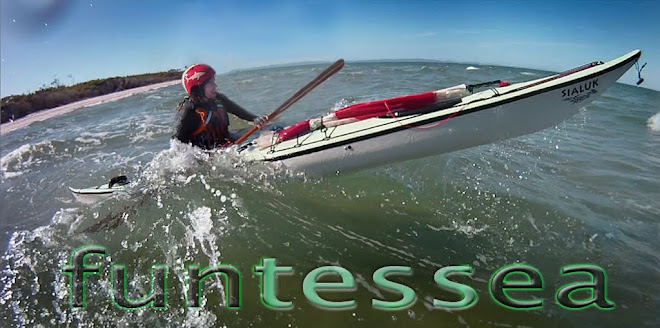
 image Damiano Visocnik_used with permission


