27 July 2010

Shark I.D.

What shark is that, bumping my kayak.....

Great White Dorsal Fin_Image http://www.sticca.info/
Acknowledgement: I would like to thank Valerie Taylor AM (Member of the Order of Australia), multi award winning underwater action photographer, film maker, marine conservationist and shark authority for sharing some of her knowledge gained from 50+ years spent underwater with her husband Ron Taylor AM (Member of the Order of Australia).
Valerie, thank you.

Valerie Taylor AM with black tipped reef sharks_used with permission

I grew up on an island with a coastline that stretches almost 50,000km linked by over 10,000 beaches. My island home has the Great Barrier Reef on its doorstep and a marine environment which is home to species found nowhere else in the world. My island home is Australia.

Growing up surrounded by oceans and enjoying her bounty, you might expect I would be knowledgeable of the marine life, including sharks. While most Australians live within 50km of the coast, not all venture regularly into the water or have any real understanding of its inhabitants. Like most Australians, the foundations of my knowledge of sharks or in this case ignorance of them, was gleaned from the trusted newspaper, nightly news bulletin and movies. Between JAWS and Vic Hislop, I was totally brainwashed into being fearful of the ‘killing machines’ waiting to hunt me and eat me alive the moment I stepped into the ocean.
Thank goodness internationally renowned conservationists and underwater film makers
Jacques Cousteau and Ron & Valerie Taylor were also on screen in Australia in the 70’s to offer us a factual perspective.

Diving with Tiger Shark_Valerie Taylor AM, Ron Taylor AM, Stan Waterman _Image g-na
As sea kayaking takes place in the marine environment it is interesting to note from recent conversations and forum entries that while we may have lost some of the paralysing fear associated with sharks, ignorance still abounds. We laymen don’t know how to identify them by sight or behaviour. Aside from being advised to avoid the sunup/sundown feeding times and churned up water at river mouths where an inquisitive bite could prove detrimental; there is little factual information available about shark behaviour around kayaks (in Qld anyway). For example, a recent touch up between a kayaker and a shark in Moreton Bay was immediately presumed to be by a Great White, even though no one saw the shark. It piqued my interest as my limited understanding was that Qld was not the preferred environment for Great White sharks. Surely there are other species of sharks more commonly found in Moreton Bay which may have tasted the hull?

Tiger Shark 'stripes' Image_g-na
Preferring facts to sensational speculation, I sought to find out more from acknowledged authorities. Fortunately, multi award winning underwater action photographer, film maker, marine conservationist and shark authority Valerie Taylor AM offered the following insights*. Ms Taylor advises that her expertise comes from her background as a diver, not a sea kayaker although you cannot argue that her phenomenal knowledge of sharks is undisputed:

Dear Tess,
Some female Great Whites go north to pup probably so their daddies do not eat the new born. They have been tracked swimming up the coast then swimming back. One was seen in the early 70s off Heron Island and photographed by an American called
Stan Waterman. It was small, 2 meters. Smaller G Ws eat only fish. A big one has been seen by Peter Piggot (Uncle Pete's Toy stores) from a helicopter in Morton Bay. It was probably a female. They could follow the whales up the coast but there are many other sharks that hang around whales when they give birth mainly to eat the after birth. Not even a GW would take on a female whale protecting her young.
There are far fewer sharks off our coast than when I was young. In the 60s 70s we saw them constantly while diving and snorkelling. Now we rarely see them at all unless we go to a no take zone or protected area, then it is mainly the harmless Grey Nurse or Wobby.
If we see a shark in the wild while diving we consider ourselves lucky. If you see one while paddling enjoy the experience.
Regards Valerie Taylor AM


Great White_Image g-na
Since taking up sea kayaking, I have had close encounters with Humpback whales, dugong, dolphins, rays, sea snakes and turtles but seldom sharks. The handful of encounters with sharks has included an evening paddle where I was briefly accompanied by a dorsal fin; a Tiger shark surfacing to investigate in the passage between Moreton and Stradbroke Islands; I’ve been aggressively ‘bumped’ from below and followed by what I believe was a large shark, although it did not break the surface. My experiences are not unique as many sea kayakers would have similar experiences.
Tom Nicholson of
Elver Paddles recounted this recent experience*, while he was paddling his hand made, skin on frame Greenland kayak off the northern NSW coast. Tom raises interesting questions about identifying shark species from dorsal fins, something I’ve wondered myself.

“On Saturday a cranking southerly was blowing. Perfect for a run from my place to Woolgoolga, 15km up the coast.I headed out in my F1 though dauntingly big surf, 3/4 expecting to be pounded back onto the beach. But my little boat really surprised me and we made it out the back. Guessing some solid 5 foot swell coming through. Once out there I headed north. I barely needed to paddle, other than to make sure I caught the swell when it was breaking behind me, and a bit of steering, as my little sail just cranked - plenty of speed bubble noises, and planing down swells.. at speed the F1 feels like it 'pops up' and planes.Half way there off Sandy Beach (yup it really is called that.. creative buggers round here..) I saw a large D shaped dorsal fin. Ragged trailing edge, sharky slow movement and a _large_ shadow, that seemed about the same proportions as my boat. No tail fin out of the water. Not great visibility of the body because of the wind chop.It was not a whale, and it wasn't a dolphin. ... clearly, it was a biggish shark. And it was turning across my bow, heading round.It certainly gave me some impetus to paddle!! Irrational cause 4 or 5 kts isn't going to out run a shark, but I felt much better paddling a bit away from it.Anyway the paddle was great, saw a whale, a pod of dolphins, some albatros and skewas (sp) and had a mighty nice time out there. Woolgoolga was beautifully sheltered, with offshore wind, and little waves for landing.But I can't ID the shark.From a bit of googling it looks like a great white fin shape, but does anyone know of a dorsal fin shark id method? I'm imagining a nifty poster (What shark is that?) Any help appreciated.”
TomN

www.elverpaddles.com
First published on SeaKayakForum Sun 25 June 2010

Tiger Shark_Image Willy Volk
There has been speculation on whether certain attributes of a sea kayak might attract a shark’s interest over others; hull colour; rudder acting as a lure; solo kayak or the straggler in a group of paddlers. Ms Taylor kindly responded to these and Tom’s questions below.

Dear Tess,
Interesting observations. Few sharks swim on the surface normally but some of the larger species will swim to the surface to investigate the unusual. Hammerheads (the smaller species) often swim on the surface with their dorsals out. They seem to like the sun. Sunfish or Mola Mola often mistaken for sharks do the same and their fin looks like that of a shark. They grow very large but eat jellyfish. They usual swim slowly. Tiger sharks have a curious nature. We have had them come up to check out our dingy and any other thing that they see floating. They have very sweet natures around divers, never aggressive (that’s our experience) but we know when working with them not to swim on the surface and when exiting the water if we have been working with a tiger we get out fast. One guy who does a lot of work with them has had 7 cameras that divers let go for a minute and they floated up taken by tigers. Warning - never swim after your camera, just let it float away if you are filming tigers. They will eat anything they do not understand. It is a test, remember sharks have no hands they feel with their nose or teeth, most of the cameras were later found still floating. The sharks had spat them out.

Great Whites also are very curious. They generally do not have a sweet nature. In the 70s we did a lot of colour tests with Great Whites. Their favourite colours seem to be cream, yellow and orange. In the 1980s we did colour tests for the US navy (they were testing the safest colour for the plastic bags that a downed airman could float in). Dark green like a garbage bag seemed best and I think that is what they use today. The US navy tests were in the tropics. No Great Whites.
Now, about the fins, even we have trouble identifying a shark by its dorsal fin but with a GW there is usually a tail fin at least breaking the surface a little. Tom’s dorsal sounds like a sunfish or perhaps a tiger. A Hammerhead would I think avoid you. They are very hard to approach when on the surface. I think a GW would move fairly fast though we have mostly seen them around baits in a feeding pattern. The few time we have encountered them without baits they were moving much faster than you could swim.
Bull sharks will also investigate the unusual specially something splashing around on the surface like a dying fish. They like the G White also investigate by biting which is why most swimmers on the very rare occasion contact with a Bull is made, are bitten then let go. Bull sharks are fish eaters but a bite in the water can bleed out a human very fast. Most deaths from shark attack are caused by loss of blood.
If I had a kayak I would never have the bottom a hot bright colour. As for white, well a lot of fish, sharks included have white bellies which must make them hard to see from below when looking up towards the sky. If a shark was investigating me in a kayak I would keep still, float like a log not splash around like a dying fish. If contact is made a jab in the gills with your paddle will have the shark showing great respect. No predator expects its intended prey to fight back. They expect it to try and escape.
Hope the above answers some your questions but remember my experience comes from being a diver not a paddler.
Regards Valerie Taylor AM


Bull Sharks_Image AlKok

Hammerhead Shark_Image ClifB

Sunfish or Mola Mola_Image jillmotts

Sunfish fin_Image gripso banana prune
Valerie’s information is interesting and offers a lot to think about. There is still plenty more to be learned. The Moreton Bay ‘touch up’ could have been a Great White but seems more likely to have been a Bull or Tiger shark. Regardless of type of shark, paddling a kayak that gets 'taste tested' would be memorable.
It seems dorsal fin identification may be a long way off yet and given their diminishing population, the chances of seeing a shark during a trip is rare. When Tom’s heart rate returns to normal, he may realise how fortunate he is to have had the experience.
You may have your own facts or close encounter to share, I would be interested to hear from you.


Postscript 4 Aug 2010:

from Valerie Taylor re
Duane Strosaker report on Qajaq USA Greenland Kayaking forum 2 Aug 2010:
Dear Tess, Very interesting. The shark behaved as I would have thought it should. One small point I did not make when I wrote. Is if the shark cannot dig its bottom teeth into the intended victim (in this case a fibre glass hull) They will not bring their top teeth down with any force. This is maybe because they do not want to break them off or perhaps the subject is not tender and juicy like a fish or sea lion. I noticed this over 100 times during the mesh suit tests. To get the shark to bite properly I had to have a tuna fillet tied to the outside of the suit (they like tuna best) otherwise they would just give a test bite dislike the feel of the mesh and let go. Unfortunately a test bite from a well armed animal can cut through human flesh and veins very easily, it does not have to be aggressive just curious as the shark in the story you sent me seemed to be.
Regards Valerie

g-na
,Stan Waterman, Valerie Taylor AM, Ron Taylor AM Jan 2010
*Used with permission of the author
**Information provided by Valerie Taylor AM relates to questions asked about regions in northern NSW and Queensland Australia.

Postscript:28 October 2010
Eric Soares has published a story titled 'How to Deal with Sharks'.
The story includes shark encounters, tips on dealing with sharks and why it is always a good idea to listen to your kayak instructor.

01 July 2010

Kayak Surf Skills

Starring: Craig McSween
Co Starring: Martin, Gavin, Gary, Vanilla, Gnarlydog and Adventuretess
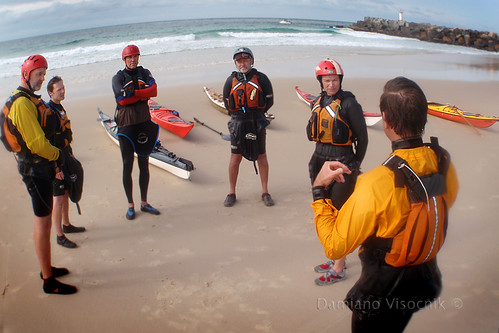
Craig beach briefing_1 (c)
A wise man of sea kayaking once told me "begin kayak surfing by playing in waves which feel comfortable. Over time, move to bigger and bigger waves, which still feel comfortable. Do things (waves) in increments, slowly acclimating yourself to a particular size until you feel the need inside to try something more challenging. If that voice inside you doesn't appear, then you are not ready to go for bigger waves. So don’t let anyone force or talk you into something you are not ready for. Also, if you are going into the surf, expect to get wiped out. There is no shame in that. The trick is to know how to get wiped out". Commander Eric Soares. Good advice.
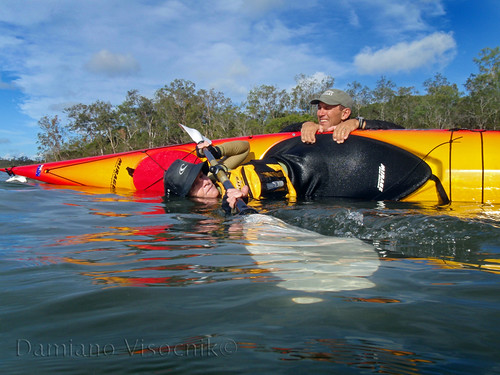
I was upside down. My eyes closed, I could feel bubbles fizzing around me as waves rocked my kayak in the surf. I was here to build on my surf skills.
I guess the lesson had begun.
Relaxing, I rolled up only to be hit in the chest and pushed backwards by another breaking wave. Laughing, adrenalin pumping, I felt alive.

My kayak surfing skills had been put on hold over summer. During the warmer months my favourite beaches are heaving with surfers, stand up paddlers and swimmers. Not enough space for me to safely practice my developing skills. Frustrated by the lack of time in the surf, I eagerly grasped the opportunity to participate in a formal surf session with one of Queensland’s leading sea kayak instructors, Craig McSween.
I’ve know Craig for several years. In fact, he introduced me to sea kayaking. His easygoing manner belies enviable skill and an innate understanding of the complexities of the sea.**
At the seawall (c)
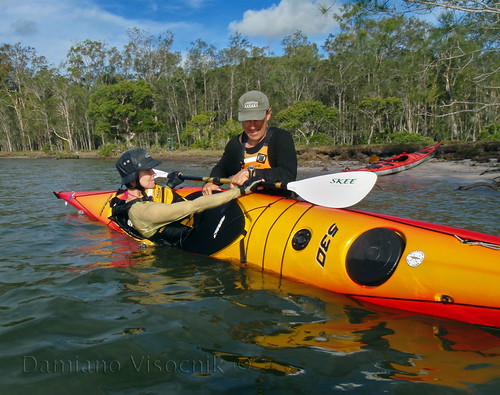
The objective of this session was to push ourselves in the surf within the boundaries of common sense. Conditions were mild but provided enough energy to achieve our objective and have some fun. Following a thorough briefing and warm up, the helmeted group of 6 hit the water.

Locating a section of surf without the usual mob crowding the swell, Craig outlined each skill then provided a demonstration. Craig’s ability to impart real life knowledge gives his training an edge not found in text books. Under his guidance we ventured backwards, forwards, sideways and at times upside down through the surf. I had flashbacks of the anxiety of going for my driver’s license; hill start, parallel park, reverse, merge...

Until now I believed my days of doing cartwheels were left behind in childhood. Martin cart wheeled and rolled perfectly. His first, he wore an elated yet stunned expression on his face for some time after. Gnarlydog managed 3 cartwheels and rolls as he battled in and out through the breakers. Gavin and Vanilla displayed their usual elegance under pressure and I’ve no doubt Gary was low bracing in his sleep that night.
Craig beach briefing (c)
I cannot speak for anyone else but Craig's confident relaxed attitude gave my confidence a nudge and whet my appetite to play more often in the surf.

**Craig's interest in sea kayaking led to the inception of the Qld Sea Kayak Club. Craig continues to provide training, tours, equipment and advice to Club members, tourists and members of the public through AdventureOutlet, his Gold Coast business.

16 June 2010

Lime Pocket Weekend

Starring: 30knot Melt, Gillian, ‘Little Ripper’ Skipper Rob, Vanilla, Gnarlydog, Adventuretess
Special Appearances: ‘Little Ripper’, 70 black swans, 140ml rain and 30knot winds
when_it_rains_it_pours_(c)DV
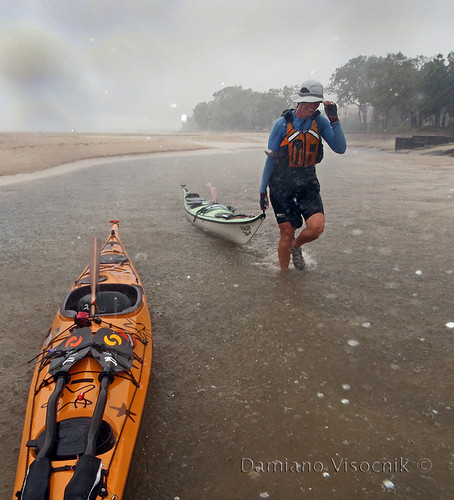
From beneath the brim of my rain soaked hat, I surveyed my companions. Heads bowed into 30knot wind to protect naked eyes from the sting of lashing rain, progress was slow but steady. The force of a sudden stronger onshore gust momentarily surprised me. It was at this moment Vanilla suggested we all kayak roll…

24 hours earlier…

The Queensland weather was turned to ‘sauna’ hot.

Our group would be camping remotely on the northern end of Bribie Island. Paddling to meet the others at the launch site, the early morning air was sultry, yet unusually clear and still. Buildings 12km away across the bay were clearly visible.

Kayaks loaded with ultralight camping gear and gourmet food, we made our way north where we would rendezvous with Skipper Rob from ‘Little Ripper’, the only non kayaking member of the group.
Zigzagging around the many sandbanks scattered up the shallow passage, local birdlife was abundant, but the dolphins, turtles and sting rays commonly seen here stayed hidden below us in the cool water.
The humidity as we paddled was unrelenting, causing droplets of sweat to trickle uncomfortably down faces, backs and cleavages.

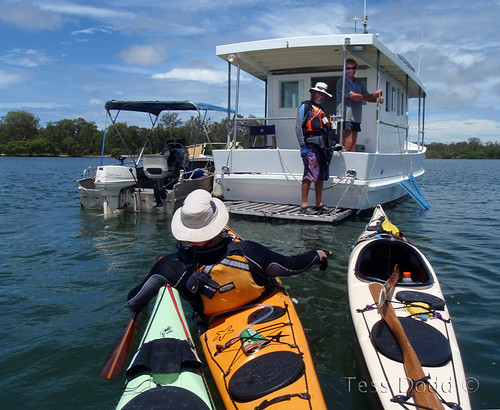
Halfway to our campsite we located the 'Mothership'.
support_vessels_(c)TD
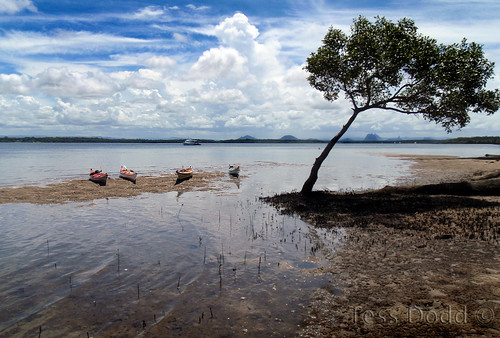
Landing nearby, views of the distant Glasshouse Mountains were superb. The antics of the resident birds entertained us while we ate lunch.
low_tide_(c)TD
We continued to enjoy the panorama as we followed the channel toward Lime Pocket, our overnight destination. There are no facilities or drinking water there. Campsites are nestled privately in the bush along the passage. As we passed the Mission Point campground, I was pleased my companions were also interested in remote camping, as the campsites and beach here were overflowing with boats and people.

Reaching Lime Pocket, we quickly set up camp as Skipper Rob arrived and set anchor. Rob promptly cast a fishing line and an amused eye over us as we swam and enjoyed a session rolling the now empty kayaks.
passing_on_the_knowledge_(c)DV

Melt_passing_on_the_knowledge_(c)DV
Rolling novice Gillian keenly listened as Melt introduced her to some basic skills. Gill was later rewarded with a hot shower aboard the ‘Mothership’.

Skipper Rob extended his hospitality to the whole group making several trips in the tender collecting some for showers and the rest for refreshments. Recharged, we shared a substantial happy hour on the back deck of ‘Little Ripper’ as the sun set. Once darkness descended, ‘popping’ noises could be heard on the surface of the water surrounded the boat. Efforts were made to try and catch the elusive fish before Rob returned us to shore for dinner.
Evening temperatures were still warm. Gourmet dinners were prepared and eaten quickly, as the mozzies began feasting on us.

During the night the rain came. 140ml of it. Rain. And more rain.
bucketing_(c)
After a night of record breaking rainfall, the downpour eased as dawn arrived.
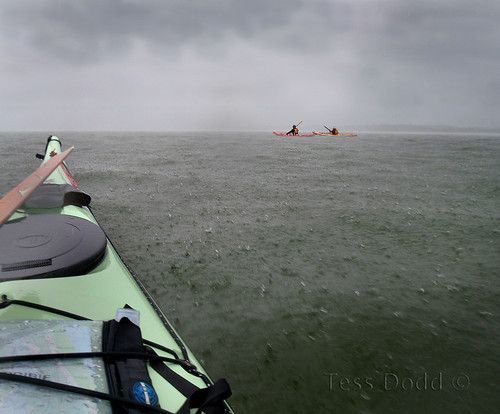
Launching back into the passage, the weather could not have been more different to the previous day. The volume of rain in the passing showers was incredible. Once again passing Mission Point, the beach and campground were now deserted in stark contrast to the previous afternoon.
Paddling_in_the_rain_(c)TD
Virtually alone on the water we again had only the birdlife for company. Flying above us was an enormous stork whose size was likened to an albatross. Ahead on a large sandbank were elegant shapes that were difficult to identify in the conditions. As we drifted closer, we counted 70 black swans striking poses in the rain.

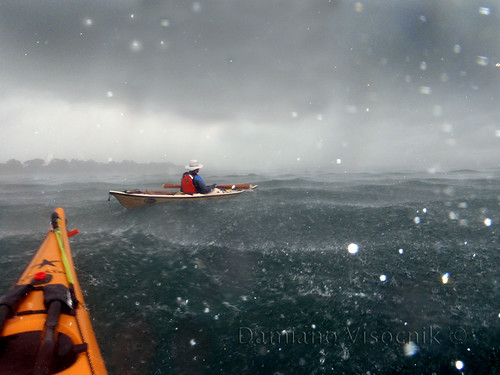
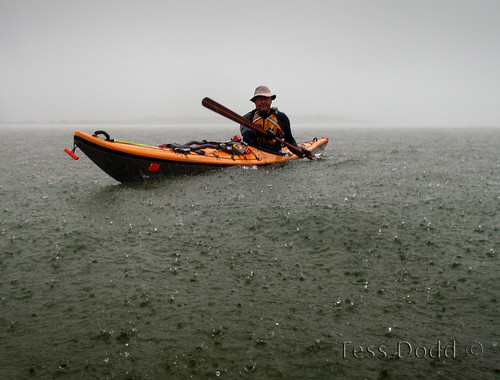
We returned to the original launch site to farewell 2 group members, while those remaining continued. Incredibly, within minutes of leaving ‘30knot Melt’ behind, a 30 knot squall was upon us. The driving rain pelted our faces and flattened the tops of surrounding waves. It was fantastic and energising to be out there!
Vanilla made the suggestion to roll as the squall momentarily increased. The 3 remaining kayakers rolled as requested, observing the muted silence in those few seconds under water.
pouring_(c)DV
On this trip I found that using my Aleut ‘Bling stick by Van’ was easier than the larger bladed euro style paddles I have used in similar conditions on other trips.
The combination of varied conditions, magical wildlife, remote camping and exceptional company made this weekend an absolute cracker – one of my all time favourite overnight trips.

22 February 2010

Teen Greenland Rolling

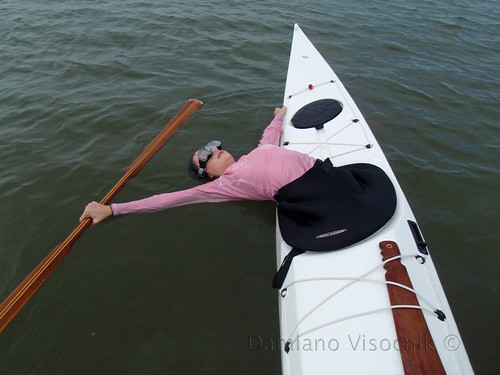
Mini-Me does rolling
Starring: Greg Schwarz & Mini-Me

Loving this sport as I do, I sometimes wonder how much more I could achieve if I had started sea kayaking earlier in life - what an advantage to soak up kayak skills when you are younger, braver, have more energy and more importantly, youthful flexibility.
minime balance brace (c)
I recently had the pleasure to be part of a small group practicing balance and rolls in a variety of sea kayaks where one of the group, was a young girl.
Prior to this, the girl had only paddled a friend’s plastic kayak with a large recreational cockpit and no bulkheads for a half hour during a picnic.

This was her first time paddling a sea kayak. She chose a Greenland paddle and skeg boat (Norkapp LV) and surprised us by listening carefully and applying advice that was offered on the intricacies of forward stroke and body rotation. She spent some time paddling up and down the beach practicing the stroke and in turn, offered critique on some of our forward paddle styles.

Observing others rolling, sculling and balanced bracing, she surprised us again by asking if she could try some of the things we were doing.
Paramount to any beginner’s success is having a kayak that fits and access to skilled mentors and while none of the kayaks were a perfect fit, she was fortunate that Greg Shwarz was among the group. Under Greg’s guidance she began balanced bracing a Tahe Marine Greenland kayak almost immediately!
minime balance brace_1 (c)[1]
Only minutes later she grasped the technique of sculling and it was only because she was underdressed and shivering from the cold water that she didn't learn to perfect a roll.
Next time, suitably dressed for immersion, maybe she will surprise us with a hand roll? :-)

27 January 2010

Butterflies and Hand Rolls - Australia Day 2010

Starring: Greg and Moira Schwarz, Gnarlydog, Adventuretess

Australia isn’t only about vegemite, koalas, mateship and cockroach races at the Story Bridge Hotel, it’s about living the Aussie dream and ‘having a go’.


After returning a day early from Fraser Island, I decided to spend my bonus day off pursuing my current Aussie dream, to hand roll my kayak.


An impromptu session with rolling mentors Moira and Greg Schwarz was arranged.
Watching Greg and Moira’s effortless balanced braces and Greenland rolls has inspired me to ‘have a go’.


It isn’t always pretty, but I have a lot of fun testing the boundaries of balance in my kayak. Without their guidance, balanced bracing would just be some weird thing that those kayak roll specialists do.
Armed with determination and a neoprene oven mitt, we met Moira and Greg among the patriotic hordes setting up bbq’s and esky’s along the grassy shorefront.
I’ve been attempting hand rolls for a short time and I just couldn’t quite pull it off. Almost reaching the back deck and then failing, my bare handed sweep wasn’t working for me. Warming up with a short paddle and a few rolls, I carefully studied Greg and Moira as they performed hand rolls.
I put the neoprene glove on and listened carefully to Moira’s instructions.


Before I knew it I had rolled and was lying on Sialuk’s back deck looking into the sky.

Success!


Tentatively I tried again, to make sure it wasn’t a fluke. Feeling more confident, I tried it again and sure enough, up I came.
By this time, I was getting excited and wanted to try it one more time before going commando (without the glove). Well, the magic left me and my hand rolling came to an end. Moira comforted me with assurances that this was common when learning to hand roll. It comes. And it goes.
Taking a break we all swapped kayaks and I watched as Moira hand rolled, Greg elbow crook rolled and Damiano butterfly rolled in Sialuk – his first!
Moira paddles an Avocet LV and the cockpit fits me very well. I decided to try the hand roll one more time and surprising myself, I managed to hand roll a further 3 times in the Avocet LV before the magic washed off.
We 4 left the beach satisfied. For a few short hours we’d all ‘had a go’ and ‘lived the dream’. Sharing celebratory ice creams afterwards, I was a very happy kayaker.

Team Vanstix 3 Days at Fraser Island

QSKC Australia Day Weekend at Fraser Island
Starring: Team Vanstix


I love a sunburnt country
A land of sweeping plains
Of ragged mountain ranges
Of droughts and flooding rains.
I love her far horizons
I love her jewel-sea
Her beauty and her terror
The wide brown land for me!

~ extract from ‘My Country’ by Dorothea McKellar

This poem has resonated with me since I first learned it in Year 7 at school. It often comes to mind during trips. Dorothea McKellar was only 22 when she wrote about the drama, hardships and beauty of life in Australia.

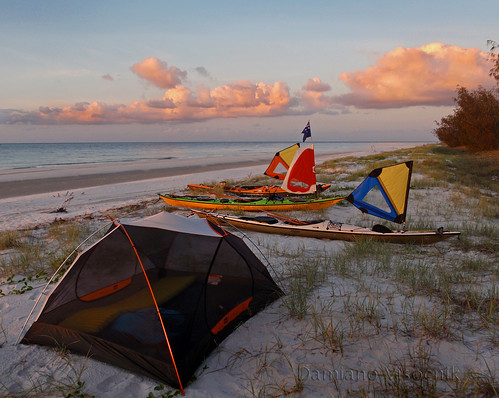
Sails at sunset_Fraser (c)
While the majority of the local paddling community were content to spend another weekend in Moreton Bay, our QSKC group decided to take advantage of a rare 4 day weekend to travel to the more remote location of Fraser Island.
During winter, Hervey Bay and the waters off Fraser Island are bustling with commercial whale watch boats vying for glimpses of migrating Humpback whales and their calves. In summer, the warm temperatures and public holidays attract 4wd campers who tend to stay inland or on the eastern side of Fraser, leaving the western side peaceful in comparison.
Launching from Urangan we quickly reached Big Woody Island, negotiating the shallow water surrounding the island before eventually rounding the rocky southern tip. After leisurely investigating the southern beach, we made the crossing to Moon Point on Fraser Island with sails up. Bracing with FEKS (c)

Rounding Moon Point, the tantalising view of foliage rimmed by white sand and clear turquoise water spread out before us. As we headed along the beach we began looking for campsites. A friendly yachty moored close by warned us of the sandflies waiting to ambush us on the beach.
Having spent time in bug infested locations around the world; we laughingly assured them a few sandflies wouldn’t diminish our enjoyment of the surroundings..…Famous. Last. Words.
Camp at Fraser (c)
Unfortunately, we had no sooner set up camp and sat down to enjoy happy hour together than the ambush began.
The yachties were right and we watched enviously as they relocated further offshore for the evening. The onslaught of all things biting was relentless. Sandflies; biting black flies; green march flies; monster black flies; mosquitoes.
Fully dressed and smothered in various strength repellents including the usually reliable Sand Fla Van and DEET, one member of the group surrendered and retreated to his tent, the ONLY safe haven. Another member cloaked himself in a large mosquito net, to no avail. Dinner was prepared as quickly as possible and eaten together in 1 tent, where we were finally able to relax.
Rising early in the morning we noticed that there were no signs of the usual evening visits of local dingoes. Perhaps the insects had driven them away? We quickly packed up camp and without stopping for brekfast, were on the water to continue our trip in record time.
The air temperature was warm and so was the water. As we paddled, the swell running onto the beach created waves to play in.
Van bracing (c)Vanilla bracing on shore breakers Reaching Woralie Creek early, we were pleased to see only 2 others in camp. Surveying the campsite, it was extremely disappointing to see places we had previously pitched tents now littered with toilet paper, illegal fire pits and the blackend remains of fires. Aside from the fact fires are not allowed on Fraser Island, the fact that the fires had been made on the flat areas leaving only sloping sites to pitch tents on, offered an insight into the intelligence of the fire bugs.
It also raised questions about the management of this world heritage listed island. Perhaps along with Dingo warning signs posted around the island, there should be instructions on how to shit in the bush. Dingoes will dig up anything that isn’t deeply buried, so if you are merely covering your waste with a piece of bark or leaves, you may as well not bother. It’s also highly desirable to do it away from the campsite, not just at the base of the tree closest to your tent!

The QSKC in partnership with Leave No Trace Australia promotes minimal impact camping on all club trips; small groups using sound environmental practices. Information on minimal impact camping and kayaking can be found on the QSKC and LNT websites.

The afternoon was spent rolling and playing just off the beach and as darkness enveloped us, a pleasant evening was spent out in the open, the biting insects at this campsite deterred by clothing and repellent.
sunset paddling_3
A dawn text message relaying a family emergency forced a change of plans. After another fast pack up, we were quickly on the water for the return paddle to Urangan. Averaging over 8km per hr, we had moments of welcome excitement crossing sandbanks with tide rushing over them. Small following seas and a tail wind in our sails assisted us with our 35km return trip to Urangan harbour.


06 January 2010

Scarborough to Bribie - Keeping the Skin on my Tail

Starring: 8 members of the 'Claytons Group', Greg Schwarz, Gnarlydog, Adventuretess


Gnarlydog using his Flat Earth Kayak Sail and Elver Greenland paddle

The original seat in my Nordkapp LV ‘SIALUK’ has been rubbing the skin off my tail on trips longer than 15km. Very fond of the hull's shape but not of the "furniture", I tried, among other things, heat deforming the seat to change its shape but ultimately the best solution on longer trips was to duct tape the area on my butt that was likely to be rubbed raw.

Gnarlydog made me a new seat in the MEI (Multisport Expeditions International) workshop. After a week playing with kayak rolls, I decided to test the new seat during a 27km social paddle with members of informal kayak group The Southeast Queensland Sea Kayakers or 'Claytons Group'.

11 kayakers launched at Scarborough heading for Bongaree on Bribie Island, Group members quickly settled into their own paddle rhythms, the lack of breeze making the trip humid. Optimists in the group kept sails raised, hopeful to catch any whisper of wind. Unchallenging conditions combined with eager paddling made for a fast arrival at Bongaree.


Reaching the sand beach, some opted for a refreshing swim in the inviting water, while others practiced rolling. I separated from the group here to share lunch with some locals before paddling back to Scarborough later in the afternoon.


Afternoon sail

Sailing back, we noticed smoke flares and activity in the distance. The local Coastguard was undertaking a training activity, using a rescue helicopter to transfer people from water to moving boat and back again. Staying low to water and boat during manoeuvres, the ability of the chopper pilot was impressive. Watching the surface water dispersed by the hovering helicopter, I wondered about the effects the downdraft might have on a kayak....

Landing back at Scarborough with the skin on my tail intact, I was very happy with the new kayak seat, which only need minor mods to be perfect for me.