Showing posts with label sea kayak skills. Show all posts

24 May 2011

Special Dolphin Sighting

surfing wind waves_4
Playing in rough water off Bribie Island in Moreton Bay, I noticed a strange looking dolphin jump out of the water and flip onto its back not far from me. I quickly paddled over to have a closer look, but it had disappeared. There are at least 8 dolphin species recorded in Moreton Bay so it is not uncommon to see them when paddling in the area. However since the Brisbane floods, visible marine activity has been minimal so I was quite excited by the close sighting.

used with permission_Ken Douglas
A short time later, as we continued to play, the same thing happened again. This time Gnarlydog also saw the dolphin and pointed out that it wasn't a dolphin, but a shark approx 4 - 5 ft long. It was quite dark on top with a white belly. The obvious difference was the blunt or stubby head.

Bull shark in 1m water_Alkok_used with permission
I did not feel overly concerned as the shark showed very little interest in us and while some rolling was going on, we were mostly above water in our kayaks. We continued playing for another hour or more, the shark splashing occasionally before disappearing altogether. I was keen to find out what type of shark it was as I had never seen one jump out of the water like that, especially so close to us. I contacted shark expert Valerie Taylor to ask her opinion:

Shark Conservationist and Underwater Film Maker Valerie Taylor AM
Tess
You have just described an average shark. Nearly all have white or pale stomachs and are darker on top. The blunt head sounds like a bull shark and they will jump out of the water. I have seen it several times. Do not ever get in the water when the vis is down. Predatory sharks hunt by sight and vibration. Lacking hands, if they cant see something splashing around in the water they can and often do investigate the unusual by biting. You were quite safe in your kayak specially if staying still like a log. Female Bull sharks at this time of the year are swimming into the harbours and rivers to pup. They do this so the males don't eat the new born sharks. The baby sharks will stay in the inland waters until they are big enough to hold their own in the ocean.
Regards Valerie Taylor ***

Bull Shark_Delusion Productions_used with permission
***Interview with Valerie and Ron Taylor

01 January 2011

Going Out with a Bang

For most of this year I've nursed an injury which has impeded my adventure activities. Opportunities to kayak were precious and with a little help from a Gold Coast instructor, some good kayaking DVDs, books and the endless patience of my mentors, I've experienced some quality bum-in-boat moments.
I enjoy rough water paddling and am in the process of acquiring the skills of kayak surfing. I'm fortunate to have spent the final day of 2010 with my friends in gentle surf, in my Nordkapp LV.


Team Vanstix NYE_c
Team Vanstix_Vanilla, Adventuretess, Gnarlydog NYE 2010

28 December 2010

Under Threatening Skies

While others were fighting for bargains at post-Christmas sales, or staying out of the wet weather on their couches at home, I was itching to get my kayak wet.

The only post-Christmas “sale” I was interested in involved using my Flat Earth kayak “sail”. Unfortunately the forecast was for heavy rain instead of wind, so I left the sail at home, grabbed my GP and Gnarlydog and launched under threatening skies.
FTYJ0_c
In contrast to the sky, the bay was calm and unusually devoid of boats. My body relaxed into the familiar rhythm of the forward stroke; the only sounds the occasional splash of the paddle and the ‘tic tic tic’ of rain hitting the brim of my hat. A feeling of peace enveloped me. It was 6 years to the day since I first took up sea kayaking.

Approaching the reef surrounding of our destination, the water line was clearly higher than usual, with the incoming flow encroaching on the usually dry land. The king tide was flooding the small protected bay with warm, clear water providing perfect conditions to practice sculling and rolling.
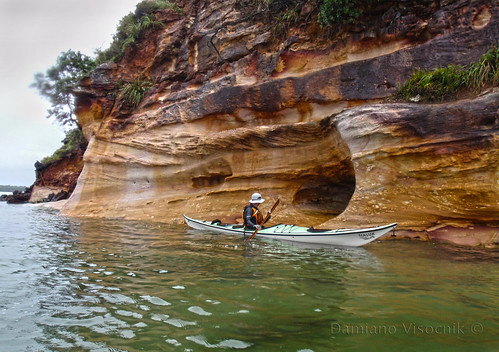
dtre45_cTaking advantage of the rare water height, we weaved a path over the submerged beach through mangroves and shrubs, inaccessible at other times. Small sandstone cliffs were reminiscent of the coastline in North Queensland, the pink colours a contrast against the surrounding dark foliage.
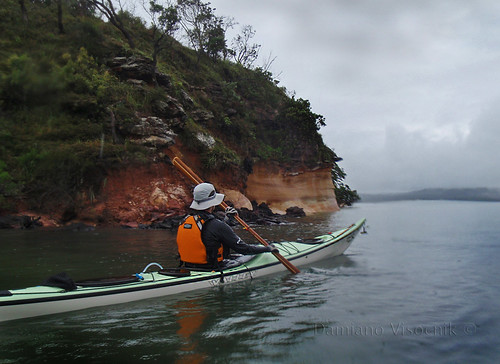
along the cliff_cThis rainy day exploration had left me with the feeling of a remote experience in my own backyard bay.

02 November 2009

Kayak Roll Preparation - "Pre-Rolling'

Like most kayakers, when I first started sea kayaking, learning to kayak roll was on my priority list.
I couldn’t wait to learn to roll believing it would be easily accomplished.
Rolling would be a key skill to letting me go where I wanted to travel in a sea kayak…out in the sea.

Armed with basic bracing strokes, I eagerly attended roll training with a qualified instructor. As I wasn't used to the reality of being upside down underwater, once in the rolling class, I soon realized that suddenly being tipped over underwater was not the most comfortable or familiar environment.
Anxiety mixed with the confusion of being upside down made learning the steps to a successful roll extremely difficult. I finished the training disappointed with my lack of progress, unsure if I would ever be able to master this seemingly complicated skill.


Looking back it is now obvious to me that if you are not comfortable upside down in the water, you are wasting your time and money attending a kayak roll class. 'Pre' rolling or priming is essential. It was only after a lot of getting wet and mucking around in my kayak that I was finally more confident underwater and ready for rolling.


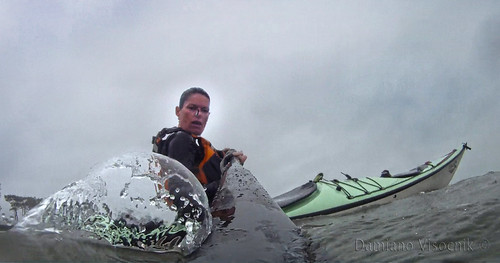
getting comfortable underwater
I’m sure there are instructors around who will take your money regardless of your readiness to roll however GOOD instructors take the time to find out if you are confident underwater, if your kayak fits you and if you use bracing and skulling strokes.

With persistence I could roll but my technique was basic (I would roll back up with force rather then finesse) and unreliable. Introduced to the intricacies of balanced bracing by Greg Schwarz, I was ecstatic when I finally learn the "balanced brace".


balanced bracing
Learning to scull and balance brace gave me confidence underwater and an understanding of how the kayak moved in the water with certain body movements.

I discovered rolling is not about strength and pushing a big bladed paddle into the water to bring me back up. Rolling is more about aligning my body with my kayak, using my body to apply opposing forces with my leg/knee that will turn the kayak into an upright position. Not all kayakers are equal: some are more flexible than others and some have better underwater orientation, so training should be adjusted to the individual.

Hanging out with Greg Schwarz I learned another "soft roll"; the "butterfly" roll.


Greg likes to 'finesse' his rolls and he loves to teach that to others.

I am not a qualified instructor but I recommend aspiring rollers to undertake a lot of "priming" before you take that class.
Become confident with wet exits, happy to hang upside down for a minute (or two) before popping the skirt and maybe, with the help of a knowlegeable friend, start some basic sweep strokes with a paddle float to learn the motion of a roll.
The chances are that unlike my first class, a prepared student will have more luck in successfully completing a roll course than one that has never tipped upside down in his/her kayak.

20 October 2009

Bribe to Moreton attempt

Starring: Vanilla, Gnarlydog, Karrazy, Gary, April, Adventuretess
Guest Appearance: Sea Snake

A late start, incorrectly loaded kayaks and a below G2 pace in challenging conditions necessitated an on-water change to the trip plan.Within an hour it became clear Bribie to Moreton would have to become Bribie to Bribie and while disappointing, the weekend was still enjoyable and a new experience for some members of the group.
Like all good kayak trips, the weekend provided group members with some learnings to reflect on for their next G2 trip. It also highlighted skills that may need to be addressed in future training sessions.
While the plan changed, the group still had the opportunity to experience paddling in 15 – 20kn headwinds against the tide and feel the effects of paddling through highly confused water, but close to shore.
Post Moreton Island oil spill, marine life is returning to this area with plenty of birdlife, dolphins and swimming crabs surrounding us as we paddled.

This 15km crossing can be intimidating, exposing you to a range of conditions. Deep channels, strong currents, shallow sand banks, container ship traffic, marine life and weather variations make this an interesting paddle with few opportunities to stop for a break. Having undertaken this crossing several times in various conditions, the trip was planned with a minimum cruising speed of 5km per hour.

Launch morning proved to be a lesson in patience for participants as en route some were forced to wait out the aftermath of a motorway accident. The group eventually assembled at the launch site where severe beach erosion made packing the kayaks close to the water impossible. Packing was carried out high up in the dunes then the loaded kayaks were carried ** to the sliver of remaining beach to launch. An hour behind schedule the group was on the water.

** http://gnarlydognews.blogspot.com/2009/10/kayak-carry-straps.html for an article on carrying loaded sea kayaks

Within an hour of launching, Gary's GPS read that we were progressing at only 3.5 km/h. This speed was well below the planned pace. A 15 – 20knot headwind, strong outgoing current and the skill level of some group members indicated reaching Moreton would take at least 6 hours – double the planned time on the water. To the disappointment of some, the decision was made to turn back to Bribie.

Close to shore, highly confused water tossed the kayaks around offering the opportunity to low brace in small pitching waves (see movie below). For some this was a welcome chance to play, for others it was an anxious first experience of ‘washing machine’ water.


As conditions did not ease as was forecast and the group were prepared for an overnight trip, the decision was made to postpone Moreton and paddle north to camp on the ocean side of Bribie Island. With the wind and current now at our tails, we made fast progress for the first time that day. The ocean side of Bribie is remote but very busy in summer with 4wd vehicles traffic and fishermen.

Scouting for a semi protected campsite in the dunes, the first 'recon' was a success. Taking it in turns to land in the small surf, off the water a quick perusal of the area confirmed several campsite choices high above the waterline. The beach here was also severely eroded so the kayaks were emptied and lifted high out of the way of 4wdrive traffic.

A pleasant pre dinner happy hour was spent together in the dune grass, contemplating the meaning of life and reviewing the day, the view of Moreton Island teasing us in the distance.

In the evening, 3 of the group opted to go ultra-light and sleep without tents. There are several lagoons on the island so ultra-light camping requires a heavy application of tropical strength insect repellent. After the success of Vanilla’s home-made ‘Sand Fla Van’ in the Whitsundays, the concoction was shared around and we settled in for another glorious night under the stars.

Woken only once during the night by donuts (not the deep fried delicious kind, but the ‘beach bogan’ tear up the beach in your 4wd kind) we rose the following morning refreshed and bite free.

Vanilla’s early morning beach walk revealed a large sea snake lying on the sand just above the tide line, close to camp. Appearing to have difficulty making its own way back to the water we were concerned that this exquisite reptile would come to grief on the busy beach. The sea snake was gently encouraged back into the safety of its water habitat.

The forecast of increasing winds encouraged the group to start early. Launching was non-eventful and we enjoyed a slow paddle back with a 10knot head wind and an occasional dolphin for company.

Arriving back at the launch site close to high tide there was very little beach to land on. Kayaks had to be quickly hauled high out of reach of the encroaching tide.

While the trip may not have gone as planned, being adaptable meant the weekend was not wasted. The decision to turn back was not made lightly. As a QSKC trip leader I lead trips that offer others the opportunity to kayak, test their boundaries and increase their skills within the safety and structure of Australian Canoeing guidelines.
Just as I learn something about kayaking and trip leading on every paddle, I hope the members of this group learned something that will enhance their kayaking experience in future.

14 October 2009

Kayak Rolls and Skills

If you enjoy accessing quality information, videos and sea kayaking links, I recommend visiting Derrick Mayoleth's website www.kayakquixotica.com
I'm currently hooked on this section of the website http://www.kayakquixotica.com/video-section/index.html it shows some great technique captured on video of different types of rolls and related skills.
When I was first learning to roll, I didnt know the difference between pawlata, C2C or sweep rolls and I recall feeling some frustration because I could only see what was happening on top of the water. As soon as the instructor went upside down and I could no longer see, it became 'secret kayaker business'.
Looking at the short movies filmed from different angles on Derrick's website provides a clear guide to what's going on above and below the water.
Rolling isnt always about survival, it is also about having fun. I can't wait to get in the pool or out on the water and try to recreate some of these moves - perhaps not the bowling ball roll (?)...
Kayaking is an in water sport after all!