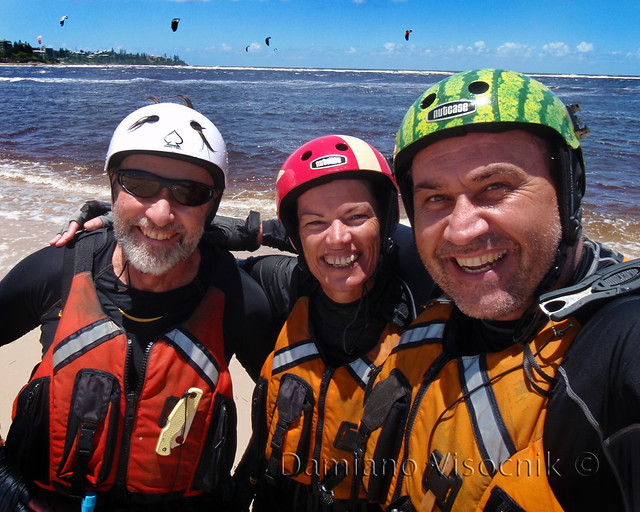
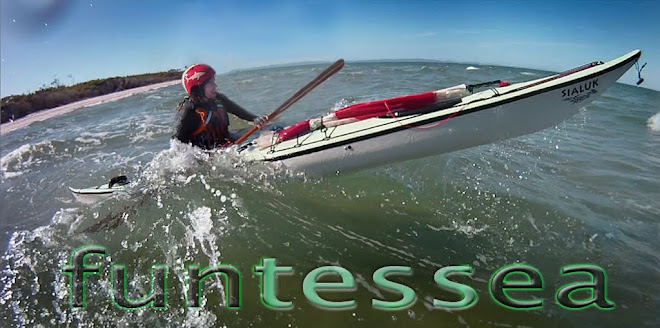
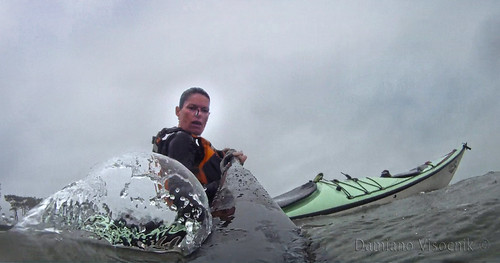
For most of this year I've nursed an injury which has impeded my adventure activities. Opportunities to kayak were precious and with a little help from a Gold Coast instructor, some good kayaking DVDs, books and the endless patience of my mentors, I've experienced some quality bum-in-boat moments. I enjoy rough water paddling and am in the process of acquiring the skills of kayak surfing. I'm fortunate to have spent the final day of 2010 with my friends in gentle surf, in my Nordkapp LV.
Team Vanstix_Vanilla, Adventuretess, Gnarlydog NYE 2010
While others were fighting for bargains at post-Christmas sales, or staying out of the wet weather on their couches at home, I was itching to get my kayak wet.
The only post-Christmas “sale” I was interested in involved using my Flat Earth kayak “sail”. Unfortunately the forecast was for heavy rain instead of wind, so I left the sail at home, grabbed my GP and Gnarlydog and launched under threatening skies. In contrast to the sky, the bay was calm and unusually devoid of boats. My body relaxed into the familiar rhythm of the forward stroke; the only sounds the occasional splash of the paddle and the ‘tic tic tic’ of rain hitting the brim of my hat. A feeling of peace enveloped me. It was 6 years to the day since I first took up sea kayaking.
Approaching the reef surrounding of our destination, the water line was clearly higher than usual, with the incoming flow encroaching on the usually dry land. The king tide was flooding the small protected bay with warm, clear water providing perfect conditions to practice sculling and rolling. Taking advantage of the rare water height, we weaved a path over the submerged beach through mangroves and shrubs, inaccessible at other times. Small sandstone cliffs were reminiscent of the coastline in North Queensland, the pink colours a contrast against the surrounding dark foliage. This rainy day exploration had left me with the feeling of a remote experience in my own backyard bay.
Lou, a friend’s daughter survived a horrific MVA which resulted in the amputation of one of her legs. Lou has been asking me how she can become a sea kayaker. After talking with her, I remembered ‘Birthright’, a moving short film I had seen. In ‘Birthright’ Sean Mullens captures Michael’s daily ritual to find his natural self through surfing. BIRTHRIGHT from Sean Mullens on Vimeo. I reflected on ‘Birthright’ and options for Lou. Sea kayak manufacturers invest a lot of time and money into developing and improving sea kayaks, but what about kayaks specifically designed for people with disability? Weren’t sea kayaks well suited to people with lower limb mobility challenges? During my search, I was drawn to Hybrid Unlimited, the project of sea kayaker Andre Janecki who is trying to develop a recreational kayak specifically designed for double leg amputees and paraplegics. Hybrid Unlimited Designer Andre Janecki Andre’s concept is that to feel free, to feel natural, feel in the moment, means you need to be independent. The Hybrid Foundation Ltd, a not for profit organisation was formed to design and develop products to support people with disabilities. Andre’s design, the Hybrid Unlimited is the world’s first kayak equipped with wheels. Hybrid Unlimited concept design Getting to, in and out of the water without assistance, is the key. Having motorised wheels would make the job much easier. In Andre’s design, quad inflatable sponsons are used for safety and durability. Seats are individually cast to the paddlers profile and a breathable top deck provides additional comfort. Aeronautical quality composites keep the weight to a minimum. This is no ordinary kayak, but neither are the paddlers the Unlimited is designed for! Intrigued, I asked Andre a few questions to try (and) better understand the Project. Andre, why is your design special? Because it's the first ever kayak with wheels! Wheels are the key factor so you can go down and up the boat ramp on your own! To feel free you need to be independent! Have you been able to test your design? To fully test the UNLIMITED we need to "stretch" the scale down model for another... 4meters (12ft)! However with over 20 years of kayaking experience I know that this kayak will perform as intended (including the fun as well as the safety factor). Do you have any indication on the demand for your design? I wish there would never be demand for it, but sadly accidents happen every day. I can't quote double leg amputees statistics, but there are 80 cases of paraplegics per year (half of it involving young men) and this is only in Australia. Will the kayak be transported on roof racks and if so will assistance or a special system be required to do so? The roof rack or the passenger seat will do. The kayak centre section which includes the 3 wheels and the seat (I call it 'a cocoon') is only 1.2meters (4ft) long and will weight no more than 6kg (16lb). You shift your self in to it like the standard wheel chair and 'zoom' around your car to pull up the paddle, PFD, lunch box, sun glasses, etc. Then by flicking a switch the car battery will inflate the side sponsons (in less than 5 minutes) and you ready to roll down. Having the wheels motorized would obviously help (specially on the way up) but for the time being a 20 meter (65ft) long thick rope with equally spaced knots will do the job. Where will the Hybrid UNLIMITED kayak be manufactured and how affordable will it be in comparison to sea kayaks currently on the market? As a kayaker I see no boundaries. I am willing to sign with anyone regardless where (and who) they are. The UNLIMITED will always remain as a "recreational special need kayak" with cost equal to a quality "expedition sea kayak". Andre, how do you fund the Hybrid UNLIMITED Project? The Concept Design is on me. I am committing $350.00 from every "Hybrid 550" (a sea kayak like no other, in Andre's words) sold worldwide to the project. But for the full size prototype we need a Sponsor with $50k. Funding is needed to purchase components and custom made features like carbon kevlar disc wheels, inflatable sponsons, vacuum mouldings, etc. Will the Hybrid UNLIMITED kayak be available internationally and how will I be able to test and purchase one? Internationally of course! But before we can test (and purchase) one, we need to find a Sponsor for this project! If there is one area I'm hopeless (and a failure!) with, it’s the correspondence to government and corporations. In September and October of 2009, I travelled through Europe, USA and Canada where the Project was well received, but we still need a major financial partner/sponsor. Should anyone wanting more information contact the Hybrid Foundation Ltd directly? By all means! I hope that together we can make it happen sooner! hybrid8@bigpond.com Finally Andre, if you had one wish what would it be? I wish for no accidents at all. But knowing the statistics I really wish for a CEO somewhere to realise the rewards for sponsoring the UNLIMITED ... at a cost equal to a replacement set of boardroom chairs!
Will the Hybrid UNLIMITED Project help Lou realise her goal? I don’t know, but a project as ambitious as this seems to sit appropriately within our sport, a sport that fosters ambitious sea kayaking expeditions and ‘firsts’. Race Around Australia's Freya Hoffmeister Hybrid Foundation Ltd image Andre Janecki_used with permission
If you have suggestions or comments to help Lou or Andre realise their goals, please join in this discussion and add your comment below.
Footnote - On 3 Dec every year, International Day of People with Disability (IDPwD) is celebrated worldwide to recognise the achievements and contributions of people with disability. One of IDPwD's aims is to involve people with disability and the broader community in activities to celebrate and raise awareness of IDPwD.
The story includes shark & marine life encounters, tips on dealing with sharks and why it is always a good idea to listen to your kayak instructor. Just as we practice recovery scenarios, recent media on sharks (giant hammerhead and great white 'lurking' off the Qld coast & the tragic loss of surfers lives in Perth W.A. and Santa Barbara U.S.A.) could encourage non-hysterical discussion among sea kayakers to plan for the unlikely event of a shark encounter - defence, first aid, kayak damage etc ? Eric's (and the other Tsunami Rangers) experience with sharks as sea kayakers compliments the information shared with us in Shark I.D. by Valerie Taylor A.M.
12 months on Vanilla, Gnarlydog and I revisted Mud Island. With a benign forecast and Gnarlydog's renowned lack of interest in flat water paddling, the only challenge on this 35km trip would take place in the mind. Fortunately Gnarly was blessed with great companions and an interesting destination. En route to Mud, Gnarlydog spotted movement across the calm passage. It appeared to be kayaks also moving north. One, clad in bright orange was particularly visible 4km away. If you want to be seen on the water, those high vis tops favoured by some really do work! Close to St Helena Island south of Mud, my attention was drawn below the surface of the water. The floor was bare here except for hundreds of small cone shells. As the water depth increased, I began to see sting rays and passed in amazed silence over a dozen turtles on the bay floor. A minor commotion in the water and swirls of black ink, left behind by a defensive fast moving squid captured my attention. Vanilla alerted us to an eagles nest precariously built on the very top of one of the super tall radio towers. It seemed to be an optimistic engineering feat but made us wonder how long any chicks would last when their first unpracticed flight was such a long way down. Crossing the deep channel between St Helena and Mud Island, the boys asked me to investigate some movement in the water ahead. As I approached the source they eagerly asked 'is it a shark'? While it is pupping season, it was only a large ray. At Mud we entered the moat like lagoon surrounding this part of the island and approached the creek entrance just as 2 kayakers, one wearing a bright orange top, were exiting. kayakdiary.net's Mark & Sue were the distant kayakers seen earlier, who were also exploring Mud Island on this calm day. Leaving Mark and Sue to continue their exploration, we entered the creek. Surprisingly, there is still matter from 2 of the 3 whales decomposing among the mangroves but only the biggest bones of the 3 whales remain on the creek floor. The creek is quite shallow even on a spring tide and the missing bones are too heavy to have simply washed away. Perhaps the EPA or souvenir hunters have removed them. Weaving through the mangroves past the remains, Vanilla and Gnarlydog chose to follow the creek while I stayed behind and took photos to compare with Kate's, taken 12 months ago. 2009_Kate Yeomans_used with permission 2010_Tess Dodd Up close, the smell was overpowering. The rancid stench stayed with me for most of the day. The edges of the flattened remains were fatty and drifting with the movement of the water. The top had hardened and was littered with mangrove leaves. Through the shallow water I could see vertebra and a rib lying on the floor beneath the floating remains. When my kayak nudged the fatty mass it startled a school of fish approx 30cm in length which swam out from underneath. While it looked and smelled disgusting, it was very interesting to see how long decomposition was taking and the effect on the immediate environment. Gnarly called out to me concerned that I may have passed out from the smell. I stayed taking photos until I could bear the smell and mosquitos no more and rejoined him to paddle further up the creek. The creek is a tight shallow channel surrounded by a submerged field of mangroves giving the feeling of being in a maze. On a spring tide you could lose your way. Vanilla was nowhere to be seen or heard which is not unusual given his low profile nature. We were unsure which direction he had taken so followed what we thought was the channel. Vanilla eventually emerged driven back by agressive swarms of mosquitos. 'Sand-Fla-Van'** was hastily produced and applied to already bitten skin. We returned to the lagoon as the tide began to ebb enjoying the chance to paddle inside the islands protective coral barrier. Conditions remained calm and returning to our launchsite we were compelled to create our own excitement, chasing and catching the small waves in the chop and mini tideraces along the way. Vanilla raised his sail but forward paddled faster than the weak tail wind. I was very happy to be in my Nordkapp LV Sialuk as my expedition boat would not have been as much fun in these small conditions.
**'Sand-Fla-Van' (Sand-Fly-Vanilla) was created by Vanilla using non toxic ingredients to replace commercial products containing DEET which destroy expensive outdoor gear. During the past 12 months, we have used it almost exclusively on trips with satisfying results. It is also multi use and has been used to stop bites itching and as a low grade anticeptic.
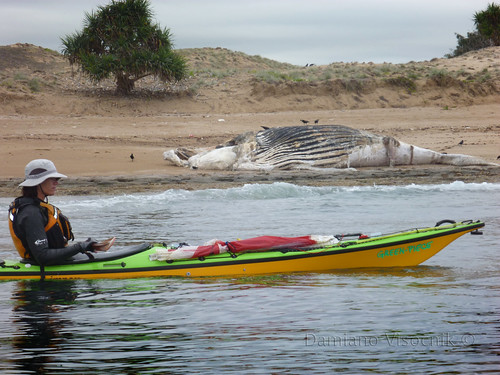
During a recent expedition we discovered a Humpback whale carcass washed up on the beach by a full moon tide. Locals later advised us that the carcass had been drifting around the area in the previous weeks. I ventured closer observing that the baleen had washed up seperately along the beach. The birds seemed to like it but I did not linger as the smell was overpowering.
Report and images from the expedition to follow shortly.
What shark is that, bumping my kayak..... Great White Dorsal Fin_Image http://www.sticca.info/ Acknowledgement: I would like to thank Valerie Taylor AM (Member of the Order of Australia), multi award winning underwater action photographer, film maker, marine conservationist and shark authority for sharing some of her knowledge gained from 50+ years spent underwater with her husband Ron Taylor AM (Member of the Order of Australia). Valerie, thank you. Valerie Taylor AM with black tipped reef sharks_used with permission
I grew up on an island with a coastline that stretches almost 50,000km linked by over 10,000 beaches. My island home has the Great Barrier Reef on its doorstep and a marine environment which is home to species found nowhere else in the world. My island home is Australia.
Growing up surrounded by oceans and enjoying her bounty, you might expect I would be knowledgeable of the marine life, including sharks. While most Australians live within 50km of the coast, not all venture regularly into the water or have any real understanding of its inhabitants. Like most Australians, the foundations of my knowledge of sharks or in this case ignorance of them, was gleaned from the trusted newspaper, nightly news bulletin and movies. Between JAWS and Vic Hislop, I was totally brainwashed into being fearful of the ‘killing machines’ waiting to hunt me and eat me alive the moment I stepped into the ocean. Thank goodness internationally renowned conservationists and underwater film makers Jacques Cousteau and Ron & Valerie Taylor were also on screen in Australia in the 70’s to offer us a factual perspective. Diving with Tiger Shark_Valerie Taylor AM, Ron Taylor AM, Stan Waterman _Image g-na As sea kayaking takes place in the marine environment it is interesting to note from recent conversations and forum entries that while we may have lost some of the paralysing fear associated with sharks, ignorance still abounds. We laymen don’t know how to identify them by sight or behaviour. Aside from being advised to avoid the sunup/sundown feeding times and churned up water at river mouths where an inquisitive bite could prove detrimental; there is little factual information available about shark behaviour around kayaks (in Qld anyway). For example, a recent touch up between a kayaker and a shark in Moreton Bay was immediately presumed to be by a Great White, even though no one saw the shark. It piqued my interest as my limited understanding was that Qld was not the preferred environment for Great White sharks. Surely there are other species of sharks more commonly found in Moreton Bay which may have tasted the hull? Tiger Shark 'stripes' Image_g-na Preferring facts to sensational speculation, I sought to find out more from acknowledged authorities. Fortunately, multi award winning underwater action photographer, film maker, marine conservationist and shark authority Valerie Taylor AM offered the following insights*. Ms Taylor advises that her expertise comes from her background as a diver, not a sea kayaker although you cannot argue that her phenomenal knowledge of sharks is undisputed:
Dear Tess, Some female Great Whites go north to pup probably so their daddies do not eat the new born. They have been tracked swimming up the coast then swimming back. One was seen in the early 70s off Heron Island and photographed by an American called Stan Waterman. It was small, 2 meters. Smaller G Ws eat only fish. A big one has been seen by Peter Piggot (Uncle Pete's Toy stores) from a helicopter in Morton Bay. It was probably a female. They could follow the whales up the coast but there are many other sharks that hang around whales when they give birth mainly to eat the after birth. Not even a GW would take on a female whale protecting her young. There are far fewer sharks off our coast than when I was young. In the 60s 70s we saw them constantly while diving and snorkelling. Now we rarely see them at all unless we go to a no take zone or protected area, then it is mainly the harmless Grey Nurse or Wobby. If we see a shark in the wild while diving we consider ourselves lucky. If you see one while paddling enjoy the experience. Regards Valerie Taylor AM
Great White_Image g-na Since taking up sea kayaking, I have had close encounters with Humpback whales, dugong, dolphins, rays, sea snakes and turtles but seldom sharks. The handful of encounters with sharks has included an evening paddle where I was briefly accompanied by a dorsal fin; a Tiger shark surfacing to investigate in the passage between Moreton and Stradbroke Islands; I’ve been aggressively ‘bumped’ from below and followed by what I believe was a large shark, although it did not break the surface. My experiences are not unique as many sea kayakers would have similar experiences. Tom Nicholson of Elver Paddles recounted this recent experience*, while he was paddling his hand made, skin on frame Greenland kayak off the northern NSW coast. Tom raises interesting questions about identifying shark species from dorsal fins, something I’ve wondered myself.
“On Saturday a cranking southerly was blowing. Perfect for a run from my place to Woolgoolga, 15km up the coast.I headed out in my F1 though dauntingly big surf, 3/4 expecting to be pounded back onto the beach. But my little boat really surprised me and we made it out the back. Guessing some solid 5 foot swell coming through. Once out there I headed north. I barely needed to paddle, other than to make sure I caught the swell when it was breaking behind me, and a bit of steering, as my little sail just cranked - plenty of speed bubble noises, and planing down swells.. at speed the F1 feels like it 'pops up' and planes.Half way there off Sandy Beach (yup it really is called that.. creative buggers round here..) I saw a large D shaped dorsal fin. Ragged trailing edge, sharky slow movement and a _large_ shadow, that seemed about the same proportions as my boat. No tail fin out of the water. Not great visibility of the body because of the wind chop.It was not a whale, and it wasn't a dolphin. ... clearly, it was a biggish shark. And it was turning across my bow, heading round.It certainly gave me some impetus to paddle!! Irrational cause 4 or 5 kts isn't going to out run a shark, but I felt much better paddling a bit away from it.Anyway the paddle was great, saw a whale, a pod of dolphins, some albatros and skewas (sp) and had a mighty nice time out there. Woolgoolga was beautifully sheltered, with offshore wind, and little waves for landing.But I can't ID the shark.From a bit of googling it looks like a great white fin shape, but does anyone know of a dorsal fin shark id method? I'm imagining a nifty poster (What shark is that?) Any help appreciated.” TomN www.elverpaddles.com First published onSeaKayakForumSun 25 June 2010 Tiger Shark_Image Willy Volk There has been speculation on whether certain attributes of a sea kayak might attract a shark’s interest over others; hull colour; rudder acting as a lure; solo kayak or the straggler in a group of paddlers. Ms Taylor kindly responded to these and Tom’s questions below.
Dear Tess, Interesting observations. Few sharks swim on the surface normally but some of the larger species will swim to the surface to investigate the unusual. Hammerheads (the smaller species) often swim on the surface with their dorsals out. They seem to like the sun. Sunfish or Mola Mola often mistaken for sharks do the same and their fin looks like that of a shark. They grow very large but eat jellyfish. They usual swim slowly. Tiger sharks have a curious nature. We have had them come up to check out our dingy and any other thing that they see floating. They have very sweet natures around divers, never aggressive (that’s our experience) but we know when working with them not to swim on the surface and when exiting the water if we have been working with a tiger we get out fast. One guy who does a lot of work with them has had 7 cameras that divers let go for a minute and they floated up taken by tigers. Warning - never swim after your camera, just let it float away if you are filming tigers. They will eat anything they do not understand. It is a test, remember sharks have no hands they feel with their nose or teeth, most of the cameras were later found still floating. The sharks had spat them out. Great Whites also are very curious. They generally do not have a sweet nature. In the 70s we did a lot of colour tests with Great Whites. Their favourite colours seem to be cream, yellow and orange. In the 1980s we did colour tests for the US navy (they were testing the safest colour for the plastic bags that a downed airman could float in). Dark green like a garbage bag seemed best and I think that is what they use today. The US navy tests were in the tropics. No Great Whites. Now, about the fins, even we have trouble identifying a shark by its dorsal fin but with a GW there is usually a tail fin at least breaking the surface a little. Tom’s dorsal sounds like a sunfish or perhaps a tiger. A Hammerhead would I think avoid you. They are very hard to approach when on the surface. I think a GW would move fairly fast though we have mostly seen them around baits in a feeding pattern. The few time we have encountered them without baits they were moving much faster than you could swim. Bull sharks will also investigate the unusual specially something splashing around on the surface like a dying fish. They like the G White also investigate by biting which is why most swimmers on the very rare occasion contact with a Bull is made, are bitten then let go. Bull sharks are fish eaters but a bite in the water can bleed out a human very fast. Most deaths from shark attack are caused by loss of blood. If I had a kayak I would never have the bottom a hot bright colour. As for white, well a lot of fish, sharks included have white bellies which must make them hard to see from below when looking up towards the sky. If a shark was investigating me in a kayak I would keep still, float like a log not splash around like a dying fish. If contact is made a jab in the gills with your paddle will have the shark showing great respect. No predator expects its intended prey to fight back. They expect it to try and escape. Hope the above answers some your questions but remember my experience comes from being a diver not a paddler. Regards Valerie Taylor AM
Bull Sharks_Image AlKok Hammerhead Shark_Image ClifB Sunfish or Mola Mola_Image jillmotts Sunfish fin_Image gripso banana prune Valerie’s information is interesting and offers a lot to think about. There is still plenty more to be learned. The Moreton Bay ‘touch up’ could have been a Great White but seems more likely to have been a Bull or Tiger shark. Regardless of type of shark, paddling a kayak that gets 'taste tested' would be memorable. It seems dorsal fin identification may be a long way off yet and given their diminishing population, the chances of seeing a shark during a trip is rare. When Tom’s heart rate returns to normal, he may realise how fortunate he is to have had the experience. You may have your own facts or close encounter to share, I would be interested to hear from you.
Postscript 4 Aug 2010: from Valerie Taylor re Duane Strosaker report on Qajaq USA Greenland Kayaking forum2 Aug 2010: Dear Tess, Very interesting. The shark behaved as I would have thought it should. One small point I did not make when I wrote. Is if the shark cannot dig its bottom teeth into the intended victim (in this case a fibre glass hull) They will not bring their top teeth down with any force. This is maybe because they do not want to break them off or perhaps the subject is not tender and juicy like a fish or sea lion. I noticed this over 100 times during the mesh suit tests. To get the shark to bite properly I had to have a tuna fillet tied to the outside of the suit (they like tuna best) otherwise they would just give a test bite dislike the feel of the mesh and let go. Unfortunately a test bite from a well armed animal can cut through human flesh and veins very easily, it does not have to be aggressive just curious as the shark in the story you sent me seemed to be. Regards Valerie g-na,Stan Waterman, Valerie Taylor AM, Ron Taylor AM Jan 2010
*Used with permission of the author **Information provided by Valerie Taylor AM relates to questions asked about regions in northern NSW and Queensland Australia.
Postscript:28 October 2010 Eric Soares has published a story titled'How to Deal with Sharks'. The story includes shark encounters, tips on dealing with sharks and why it is always a good idea to listen to your kayak instructor.
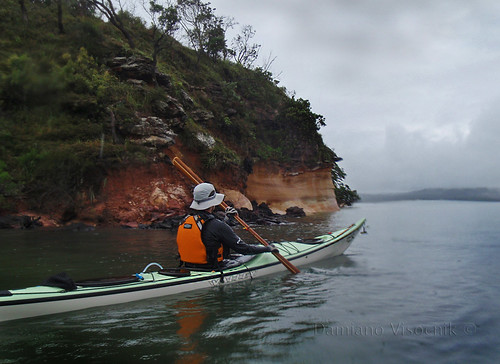
 Taking advantage of the rare water height, we weaved a path over the submerged beach through mangroves and shrubs, inaccessible at other times. Small sandstone cliffs were reminiscent of the coastline in North Queensland, the pink colours a contrast against the surrounding dark foliage.
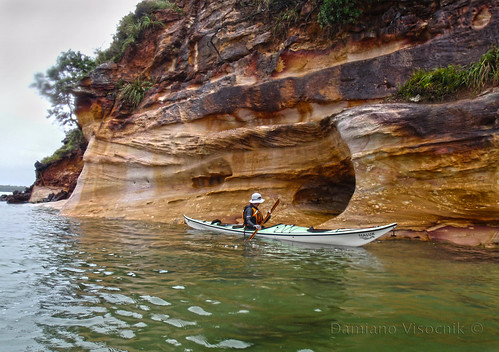 This rainy day exploration had left me with the feeling of a remote experience in my own backyard bay.